
The contingency theory of leadership states that no single leadership style is universally applicable. Effective leadership depends on matching a leader's approach to specific situational factors. That includes task structure, team maturity, leader-member relations, and organizational context. Developed in the 1960s by Fred Fiedler, this framework has since expanded into multiple models that help leaders adapt their style to achieve the best outcomes.
The premise sounds simple. But the situational variables leaders must navigate today have multiplied far beyond what Fiedler could have anticipated. For example, according to Gallup, 45% of U.S. employees used AI at work as of Q3 2025. The way people work is changing fast. So is where they work.
Nearly 80% of employees whose jobs can be done remotely are now working in hybrid or fully remote roles, as per Gallup. Teams span time zones, cultures, and employment types. A manager might lead an in-office daily scrum at 9 AM, coach a remote employee over video at 11 AM, and make a high-stakes decision in an email thread by 3 PM. Each scenario calls for a different approach.
No single leadership playbook covers all of that. Which is exactly what contingency theory predicted sixty years ago.
This guide covers all 7 contingency leadership models, compares them side by side, and shows how to apply each one in real workplace situations. Whether you are evaluating leadership fit, designing development programs, or figuring out why your style works with one team but falls flat with another, this is the resource you need.
What is Contingency Leadership Theory?
At its core, contingency leadership theory proposes one straightforward idea. Effective leadership depends on the situation. What works for one team may completely fail with another. What works in a crisis may be the wrong approach during a period of stability. There is no universal "best" way to lead.
This framework emerged in the 1960s as a direct response to the limitations of earlier leadership thinking.
Trait theory assumed leaders were born with certain fixed qualities, such as charisma, decisiveness, and intelligence, which translated to effectiveness in any situation.
Behavioral theory argued that leadership was a set of learnable behaviors, and that researchers could identify an optimal "best way."
Then came the Contingency theory, which rejected both assumptions. It argued that the right approach varies depending on who you are leading, what they are doing, and the environment in which they operate.
One distinction worth clarifying early: contingency theory is the broad family of models. Situational leadership is one specific model within that family. All situational leadership is contingency-based, but not all contingency theory is "Situational Leadership."
Why does this matter now more than ever? Modern organizations face more situational variability than at any point in history. The World Economic Forum's Future of Jobs Report 2025 found that 86% of employers expect AI and information processing technologies to significantly transform their business by 2030. Add to that the shift to hybrid work, globalized teams, and rapidly changing market conditions. The leaders who will navigate all of this effectively are the ones who can read a situation accurately and adapt.
How Contingency Theory Differs from Trait and Behavioral Theories
To understand what contingency theory adds, it helps to see where it sits relative to the theories that came before it:
| Theory | Core Belief | Leader Flexibility | Primary Focus |
|---|---|---|---|
| Trait Theory | Leaders are born with certain qualities | None. Traits are fixed | Identifying leadership potential |
| Behavioral Theory | Leadership is a set of learnable behaviors | High. Behaviors can be trained | Finding the "one best way" |
| Contingency Theory | Effectiveness depends on leader-situation fit | Varies by model | Matching approach to context |
Trait theory asks: "Who should lead?" Behavioral theory asks: "How should leaders behave?" Contingency theory asks the more useful question: "What approach works best in this specific situation?"
The Three Core Variables of Contingency Leadership
Every contingency model, despite their differences in focus and methodology, works through the interaction of three fundamental variable categories.
Leader Characteristics cover style preferences, cognitive ability, experience level, personality, and stress tolerance. Some models treat these as fixed. Others assume leaders can flex them based on context.
Follower Characteristics include team maturity, skill level, motivation, autonomy needs, and commitment. Effective contingency leadership means reading each follower as an individual, not just reading the room.
Situational Factors cover task structure, position power, organizational culture, environmental uncertainty, time pressure, and team dynamics. The same leader managing the same team through a crisis operates in a completely different situational profile than during a routine quarter.
The interplay of these three determines which leadership approach produces the best outcomes.
The 7 Contingency Leadership Models Explained
Multiple contingency models exist because the leader-situation fit equation is complex. Each model addresses a different slice of it, with different variables, assumptions, and practical applications. Some focus on the leader's fixed style. Others focus on follower readiness. Some zoom in on decision-making. Others look at the full organizational system.

No single model answers every question. But together, they give leaders and HR professionals a comprehensive toolkit for navigating almost any leadership challenge. Here is how all seven work.
Fred Fiedler Contingency Model or LPC Contingency Model

Fred Fiedler, in the 1960s, developed one of the first contingency theories. In Fiedler’s Contingency Theory, leadership styles are fixed.
You cannot change your style to suit the situation. Instead, it would be best if you put leaders into situations that match their style.
Fiedler’s Contingency Theory has two factors:
a) Leadership Style: In this factor, you determine your style of leadership. Fielder developed a scale called the least preferred co-worker scale (LPC).
The scale asks you to do the two simple things to understand your leadership style-
- Think about the person who you’ve least enjoyed working with.
- Then rate how you feel about this person for each factor and add up your scores.
According to this scale-
- The more you rate the person you least like to work with, the more relationship-oriented you are. I.e, High LPC = Relationship-oriented leader.
- The less you rate the person you like the least working with, the more task-oriented you are. I.e, Low LPC = Task-oriented leader.

b) Situational favourableness: It is the second step that determines a particular situation’s favorableness. It depends on three distinct factors:
- Leader-Member Relations: This factor measures how much your team trusts you. Greater trust increases the favorableness of the situation, and less confidence reduces it.
- Task Structure: This factor measures the task’s performance. It refers to the type of task you’re doing: clear and structured or vague and unstructured. Unstructured tasks are viewed unfavorably.
- Leader’s Position Power: This is determined by the level of authority you display to reward or punish subordinates. The more ability you have, the more favorable your situation. Fiedler identifies power as being either strong or weak.
Criticism:
- One of the biggest criticisms is the lack of flexibility. Fiedler believed that an individual’s natural leadership style is fixed. Hence, the most effective way to handle situations is to replace the leader. He didn’t allow for flexibility in leaders.
- LPC scores can fail to reflect the personality traits they are supposed to reflect.
- The model’s validity has been disputed, despite many supportive tests.
- The model does not consider the percentage of in-between situations and unfavorable situations. A clear comparison between low-LPC leaders and high-LPC leaders is missing.

Situational Theory

Paul Hersey and Ken Blanchard developed the situational model in 1969. It was initially introduced as the “Life Cycle Theory of Leadership.” Later it was renamed “Situational Leadership Theory” in the mid-1970.
Like all contingency theories, Hersey Blanchard Situational Theory also focuses on the situation. Hersey and Blanchard concentrate on the characteristics of followers to determine leadership behaviors.
In this theory, Leadership style changes as per the follower’s ability and willingness. In 1977, Hersey and Blanchard both developed their divergent versions of this theory.
- Blanchard’s Situational Leadership Theory: The semantics of Blanchard’s model used the word “Development.” He used words like “Directing,” “Coaching,” and “Supporting.”
- Hersey’s Situational Leadership II Model (SLII Model): The semantics of Hersey’s model used Readiness or Maturity. He used words like ‘Telling,’ ‘Selling,’ and ‘Participating.’

Situational Leadership Theory is a part of the two-factor theories of leadership-
a) Leadership style: Hersey and Blanchard characterized leadership style into four styles. They named each style S1 to S4. The titles for three of these styles differ depending on the version of the model.
The styles were characterized based on two behaviors-
- Task directive behavior and,
- Relationship or supportive behavior.
In the Hersey and Blanchard Situational Leadership Model (I):
| S1: Telling or Directing | S2: Selling or Coaching | S3: Participating or Supporting | S4: Delegating |
|---|---|---|---|
| The S1 leadership style puts high emphasis on directive behavior. This style has a soft focus on supportive behavior. | The S2 leadership style puts a high emphasis on directive and supportive behavior. | The S3 leadership style puts a high emphasis on supportive behavior. This style has a soft focus on directive behaviors. | The S4 leadership style puts low emphasis on both directive and supportive behaviors. |
| Individuals lack the specific skills required for the job at hand but are willing to work. They are novices but enthusiastic. | Individuals can perform various tasks. However, they are demotivated and unwilling to do their jobs. | Individuals are experienced. They can complete tasks but lack confidence and willingness to take on responsibility. | Individuals are experienced. They can perform tasks well. These individuals are willing to do jobs and also take responsibility for it. |
b) Individual or group's performance readiness level: As per Hersey and Blanchard, the right leadership style depends on the person or group being led.
Hersey and Blanchard situational leadership theory identified leadership styles into four maturity levels. They named them M1 to M4.
Maturity level is a measure of an individual’s ability and willingness to complete a task.
Blanchard’s Situational Leadership II makes some changes to the model. Blanchard’s Situational Leadership II relabelled the levels and considers development levels (D).
Development levels are considered to avoid stigma around the idea of immaturity. In Blanchard’s version, he names these levels D1 to D4 and slightly alters D1 and D2.
An individual’s development level is a combination of competence and commitment.
- Competence = level of skill, experience, knowledge, or behavior relating to a specific task.
- Commitment = motivation to learn a task and their confidence in their ability to learn.
In Blanchard's Situational Leadership model (II):
| M4/D4 - High | M3/D3 - Medium | M2/D1 - Medium | M1/D2 - Low |
|---|---|---|---|
| Competent and very willing (High competence and High commitment) | Capable but unwilling (High competence and Low commitment) | Unable but confident (Low competence and High commitment) | Incompetent and insecure (Low competence and Low commitment) |
| Followers are ready, able, and willing to perform. They are experienced at the required task and comfortable with their ability to do well. | Followers perform well on their tasks with a developed skill set. However, they are not willing to do so. | Like M1 followers, they are unable to perform a specific task but are willing to try. They are motivated to complete the job even though they lack specific skills. Often seen with new employees who lack work experience. | Followers lack the necessary skills to perform well. They are also unwilling and lack the confidence to deliver the job needed. |
| In Blanchard's Situational Leadership Model, competence and commitment are both considered high. | In Blanchard's model, commitment starts low and gradually grows as self-esteem and confidence increase, until a follower reaches D4. | Blanchard labels this D1, the first stage of development. As followers gain experience and reach D2, they gain competence but commitment drops due to task complexity. | Blanchard labels this D2, viewing it as the second stage in a follower's development. |
Criticism:
- This approach does not have a large body of research findings. It does not justify the approach’s assumptions and propositions.
- It is unclear how subordinates move from low to high development levels. It is also unclear how commitment changes over time for subordinates.
- The model does not address how demographic characteristics affect employees’ preferences for leadership.
- It does not highlight how leaders can use this model in group settings.
Path-Goal Theory

The path-goal theory was developed by Robert House, an Ohio State University graduate, in 1971. It was inspired by the work of Martin G. Evans (1970) and Victor Vroom’s expectancy theory of motivation (1964).
The model specifies the following statements-
- Leaders should engage in different types of leadership behaviors.
- Leadership style should best fit the working environment.
- Leaders' behavior depends on the nature and the demands of a particular situation.
- It is the leader’s job to assist followers in attaining goals.
- Leaders should provide the direction and support needed by the followers.
- Leaders should also ensure that their goals are compatible with the organization’s goals.

Path-Goal Theory is not a detailed process but generally follows three basic steps-
- Determine the employee and environmental characteristics.
- Select a leadership style.
- Focus on employee motivations that will help them succeed.
Path-Goal theory assumes that leaders are flexible. It believes that leaders can change their style as per different situations. The theory proposes two contingency variables-
- Environmental factors: It determines the type of leadership behavior needed to maximize performance.
- Employee characteristics: Employee characteristics determine the locus of control, experience, and ability. Personal factors of employees determine how the environment and leader are interpreted.

This theory identifies four leadership behaviors or styles-
- Achievement-oriented leader behavior: The leader sets challenging goals for their followers. They expect followers to perform at the highest level. They show confidence in their ability to meet expectations. This behavior is most effective in professional work environments such as sales environments.
- Directive-oriented leader behavior: The leader informs their followers on what is expected of them. Leaders tell the followers what to do, how to perform a task, and coordinate work. It is most effective when there is a lot of uncertainty within the environment.
- Participative leader behavior: The leader consults with their followers and asks for their suggestions before deciding. This behavior is predominant when employees are personally involved in their work. These kinds of leaders are more people-oriented than task-oriented.
- Supportive leader behavior: Leaders are directed towards the satisfaction of employees’ needs and preferences. This behavior is especially needed in distressing tasks or relationships.
Criticism:
- The theory leadership aspects it tries to incorporate are complex. The behavior, motivation, and process to apply the right leadership style are challenging.
- The theory lacks aempirical research.
- The path-goal theory fails to explain how leadership behavior correlates to followers’ motivation. The approach is only directed towards the followers. It removes the possibility of followers being able to affect change on leaders.
- The theory is complex. Hence, it is challenging to use it in every leadership scenario.
Leadership Substitutes Theory

Steven Kerr and John M. Jermier (1978) proposed the substitutes for leadership theory. This theory has evolved from path-goal theory.
Leadership Substitutes Theory is a framework. It helps to interpret the contingent relationship between leadership behavior and the outcomes. Different situational factors can substitute, neutralize, or enhance leadership behaviors.
- Substitutes- Substitutes remove leaders’ controlling power and help group members increase their performance.
- Neutralizers- Neutralizers only remove influence from the leader. It serves to weaken or block leader influence on subordinate outcomes.
- Enhancer- Enhancers are variables that serve to strengthen leaders’ influence on subordinate outcomes.
Kerr and Jermier measured these substitutes using a questionnaire.
The questionnaire has the following characteristics:
- Thirteen subscales with 55 items.
- Subscale items are listed on a Likert scale rating.
- The LPC scale ranges from 1 (completely untrue) to 5 (almost always true).
Criticism:
- When interpreting the contingent relationships, independent and dependent variables are collected. The variables are managed by the same person, causing a common source of biases.
- The study focuses on relationships between variables for a specific time. It lacks involvement in various other measures over an extended period.
- The concept of this theory is weak. It is hard to identify specific substitutes and neutralizers for broad behavior categories.
Multiple-Linkage Model

Gary Yukl developed the Multiple-Linkage Model in 1981. He proposed that the impact of leader behaviors on group performance is complex. The leader behaviors are composed of four variables-
- Managerial behaviors.
- Intervening variables.
- Criterion variables.
- Situational variables.
Good Leaders can influence the variables in several ways. These variables moderate the leader’s impact on group performance. However, the effects of leader behavior depend on the situation.
Intervening variables: Intervening variables consist of leaders’ behaviors that immediately affect employees’ job performance. A leader can influence subordinate performance by controlling the intervening variables.
Many variables of a leader’s behavior and situation correlate to subordinate performance.
Subordinate performance is dependent on four intervening variables:
- Ability to do the work.
- Task motivation.
- Clear and appropriate perceptions.
- Presence or absence of environmental constraints.
Work unit performance depends on six intervening variables:
- Member effort.
- Member ability.
- Organization of the work.
- Teamwork and cooperation.
- Availability of essential resources.
- External coordination with other parts of the organization.
Situational Variables: The situational variables that influence the follower effort are-
- Formal reward system and
- The intrinsically motivating properties of work.
In this model, two scenarios are possible-
- Intervening variables may be directly affected by situational characteristics.
- Situational variables may directly affect intervening variables.
The leader’s job is to correct deficiencies arising in the intervening variables. In the long term, the position of the leader is to improve situational factors.
Criticism:
- There are no clear claims about which leader behavior influences which situations.
- It is more of a general framework than a formal theory with precise recommendations.
- Very few studies confirm this theory.
Cognitive Resource Theory

The Cognitive Resource Theory (CRT) is a situational model. It is a reevaluation of the Fred Fiedler contingency model. Joe Garcia and Fred Fiedler, in 1987, developed this theory.
The model has the following characteristics-
- The model deals with the cognitive abilities of leaders.
- The model considers personalities, the degree of situational stress, and group-leader relations.
- The Cognitive Resource Theory explores the conditions related to leadership effectiveness. Cognitive resources refer to experiences, intelligence, competence, and task-relevant knowledge.
- The cognitive resource theory expands upon the trait theory.
- The model includes situational variables when examining leader behavior.
- Leader traits are discussed regarding how they interact with situational variables.

There are four predictions of this theory are-
- A leader’s cognitive ability contributes to team performance only in the case of directive leadership.
- Stress affects the relationship between intelligence and decision quality. Intelligence is helpful and contributes well when under pressure. Natural intelligence does not contribute and can even be detrimental under extreme stress.
- A leader’s abilities contribute to group performance only under certain conditions. Conditions include groups that favor the leader and support them and their goals.
- A leader’s intelligence correlates with the performance and degree of complexity of tasks.
There are several prepositions of cognitive resources theory:
- The first proposition is the leader’s ability to contribute to group performance. Leaders are directive when followers need guidance.
- Perceived stress influences the relation between intelligence and decision quality.
- Perceived stress moderates the relation between leader experience and performance.
Criticism:
- The theory is criticized due to the incorrectness in using factors, i.e., intelligence. It has ignored different intelligence types based on creativity, emotional intelligence, etc.
- The theory states the qualitative aspect of stress. There is no arrangement of the quantitative part of measuring employee stress.
- The theory didn’t define positive, negative stress types. Nor did it explain their impact on different leaders and leadership styles separately. A leader can be strong or weak based on different situations.
Normative Decision Theory

Victor Vroom and Phillip Yetton, in 1973, developed the normative decision theory. Arthur Jago later collaborated in 1988 to revise the normative decision model.
It helps to know how much employee involvement is necessary to make decisions. Unlike other leadership theories, the normative decision theory defines five different decision styles.
Vroom and Yetton specify decision effectiveness depending on two intervening variables:
- Decision quality: Decision quality is the aspect that affects group performance. However, group performance isn’t moderated by the effects of decision acceptance.
- Decision acceptance by followers: It is the degree of followers’ commitment to decisions.
Decision quality and decision acceptance gets affected due to the following variables-
- Follower participation while making decisions.
- The behavior used by the leader when making decisions.
- The situation is also a key factor for decision quality and decision acceptance.

The model identifies five different styles based on the situation and level of involvement. Two are autocratic, two are varieties of consultation, and one is joint decision-making.
- Autocratic Type 1 (AI): The leader makes their own decisions. They use information that is currently available to them.
- Autocratic Type 2 (AII): The leader collects the required information from followers, then makes the decision alone.
- Consultative Type 1 (CI): The leader shares problems with relevant followers individually. They seek their ideas and suggestions but make decisions alone.
- Consultative Type 2 (CII): The leader shares problems with followers as a group. They seek their ideas and suggestions and make decisions alone.
- Group-based Type 2 (GII): Leaders discuss problems and situations with followers. They seek their ideas and suggestions through brainstorming. The decision accepted by the group is the final one.
Vroom and Yetton identified five aspects of the situation. These aspects mediate the effectiveness of the decision procedure, which relates to-
- Knowledge of relevant information.
- The degree to which followers are willing to cooperate in carrying out a mission.

Vroom, Yetton, and Jago, in 1988, revised the model. They concluded the revised model by proposing seven basic questions.
These questions are on decision quality, commitment, problem information, and decision acceptance. These questions help to determine the level of follower’s involvement in decision-making.
The proposed questions of the revised model are as follows:
- Is the quality of the decision important?
- Is team commitment important for the decision?
- Do you have enough information to decide on your own?
- Is the problem well-structured?
- Would the team support your decision if you made it alone?
- Does the group share the organization’s goals?
- Is there likely to be conflict amongst the team over the decision?

Also, the new model suggests guidelines like-
- Time restraints
- Follower knowledge
- The geographical dispersion of followers.
Criticism:
- Automation of the model process is weak, and it lacks the personal factors of the leader.
- The questions used in the model may not be precise enough to reach ideal use.
- The Vroom-Yetton-Jago model may not work for a large team or group of people.
- The model ignores a leader’s orientation preference. It only considers the skills and willingness of followers.
Contingency Leadership Models: Side-by-Side Comparison
With 7 models in play, it is easy to lose track of how they relate to each other. This comparison table cuts through that. It maps every model across the dimensions that matter most for practical application.
| Model | Creator(s) | Year | Core Question It Answers | Can Leaders Change Style? | Best For | Key Limitation |
|---|---|---|---|---|---|---|
| Fiedler's Contingency Model | Fred Fiedler | 1964 | "Is this leader task-oriented or relationship-oriented?" | No. Match leader to the situation | Leadership placement and team assignment | Assumes leadership style is fixed |
| Situational Leadership | Hersey and Blanchard | 1969 | "How ready is this follower for this specific task?" | Yes. Adapt style per follower readiness | Day-to-day management and individual development | Oversimplifies readiness into 4 levels |
| Path-Goal Theory | Robert House | 1971 | "What obstacles stand between this follower and their goals?" | Yes. 4 distinct behaviors available | Motivation, goal clarity, and team direction | Many variables to assess simultaneously |
| Normative Decision Model | Vroom, Yetton, and Jago | 1973 / 1988 | "How much participation should this decision include?" | Yes. 5 decision styles available | Structuring decisions for quality and commitment | Narrow focus on decision-making only |
| Leadership Substitutes Theory | Kerr and Jermier | 1978 | "Is leadership even necessary in this situation?" | N/A. Situation substitutes, neutralizes, or enhances leadership | Autonomous expert teams and mature cultures | Hard to measure substitutes and enhancers empirically |
| Cognitive Resource Theory | Fiedler and Garcia | 1987 | "How does this leader's stress level affect their effectiveness?" | No. Stress determines which cognitive resource applies | High-pressure environments and crisis leadership | Limited modern empirical validation |
| Multiple-Linkage Model | Gary Yukl | 1981 | "Which of the 6 intervening variables needs attention right now?" | Yes. Direct and indirect actions available | Complex organizations with multiple performance gaps | Too complex for quick real-time application |
Which Contingency Leadership Model Fits Your Situation?
Understanding all 7 models is valuable. But in practice, leaders rarely have the time or context to evaluate every framework before acting. The more useful skill is knowing which model to reach for first based on the challenge in front of you.
Start with your primary leadership challenge. The table below maps the most common situations to the model best equipped to address them.
| Your Primary Challenge | Recommended Model | Why It Fits |
|---|---|---|
| "I need to assign the right leader to a team or role" | Fiedler's Contingency Model | Matches leader style to situational favorableness. Built specifically for placement decisions. |
| "I need to adapt my approach to individual team members" | Hersey and Blanchard's Situational Leadership | Maps leadership style directly to follower readiness for specific tasks. |
| "My team lacks motivation or clear direction toward their goals" | House's Path-Goal Theory | Identifies which obstacles to clear and which motivational approach fits the situation. |
| "I need to decide how much input to include in a specific decision" | Vroom-Yetton-Jago Normative Decision Model | Provides a structured decision tree for determining the right participation level. |
| "My team is highly experienced and may not need active direction" | Kerr and Jermier's Leadership Substitutes Theory | Identifies when leadership behaviors are redundant, blocked, or need amplification. |
| "I am leading through high stress or a crisis situation" | Fiedler and Garcia's Cognitive Resource Theory | Explains how stress shifts which cognitive resource drives leader performance. |
| "I am managing multiple underperforming variables across teams" | Yukl's Multiple-Linkage Model | Provides a comprehensive diagnostic for identifying which intervening variables need attention. |
In practice, the most effective leaders do not pick one model and apply it rigidly. Contingency theory itself argues against that approach. The situation determines the tool, not the other way around.
Developing fluency across several frameworks is what separates leaders who consistently read situations accurately from those who default to the same approach regardless of context.
Use this decision guide in leadership development workshops. Ask managers to identify their most common leadership challenge. Then have them study the corresponding model in depth. This turns abstract theory into a personalized development focus that is immediately actionable.
Contingency Leadership in the Modern Workplace
The 7 contingency models were developed between 1964 and 1981. The workplace has changed beyond recognition since then. But the core principle has only grown more relevant. Because there is more context to navigate now than ever before.
This section looks at three dimensions of the modern workplace that every organizational decision-maker needs to factor into their contingency thinking.
Remote and Hybrid Team Leadership
Distributed work has not just changed where people work. It has changed the situational variables every contingency model depends on.
According to a 2023 Gallup report, 52% of remote-capable U.S. employees were working hybrid and 26% were fully remote. Nearly 8 in 10 remote-capable employees now work outside a traditional office for at least part of their week. This is the new baseline.
Each of Fiedler's core situational variables shifts in a distributed environment. Leader-member relations are harder to build without physical proximity. Task structure becomes more ambiguous when managers cannot directly observe work. Position power weakens when leaders cannot rely on presence-based influence.
That is why remote leaders need to adapt their style more frequently and more deliberately. The same leader may need a directive approach in written communication, where ambiguity is high, and a participative approach in live video meetings, where real-time collaboration is possible.
Digital recognition tools fill a specific gap here. When physical presence can no longer signal appreciation, platforms that enable recognition inside existing workflows maintain the relational connection that contingency leadership depends on.

AI-Era Leadership Challenges
AI is changing the composition of work itself. And with it, the situational profile every contingency model evaluates. As AI absorbs routine, structured tasks, the work left for humans becomes more ambiguous and collaborative.
In contingency theory terms, task structure decreases as AI takes over the structured end of the work spectrum. When work is less structured, leaders who focus on relationships tend to perform better than those who focus mainly on tasks and instructions. Leaders who rely mostly on giving orders may become less effective over time.
Cross-Cultural and Global Teams
Contingency theory's emphasis on context makes it naturally applicable to global teams. But applying it across cultures requires one extra step. The situational variables themselves need cultural translation.
In high power-distance cultures, strong authority is accepted and expected. In low power-distance cultures, the same behavior can harm relationships with employees. Ways of building trust also differ across regions. A situational profile built for one market does not automatically transfer to another.
How HR Leaders Can Apply Contingency Theory
Contingency theory is not just a framework for understanding leadership. It is a practical tool for HR decision-making at every stage of the leadership lifecycle. From hiring and placement through development, measurement, and succession planning.
Assessing Leadership-Situation Fit with Data
The most common error in leadership assessment is evaluating leaders in isolation. As if their effectiveness were a fixed attribute independent of context. Contingency theory reframes this entirely. The question is not "how good is this leader?" It is "how well does this leader fit their current situation?"
HR leaders can operationalize this through data.
eNPS surveys measure leader-member relations quality across teams. A team with consistently low eNPS may not have a disengaged workforce. It may have a leadership-situation mismatch. When engagement drops after a new leader moves to a team, the signal is not necessarily about the leader's quality. It may be about the fit.
Performance data reveals task structure quality. If outputs are unpredictable and variance is high, task structure has likely degraded. The leader may need to shift toward a more directive style until clarity is restored.
Recognition frequency data works as a leading indicator. If a leader's recognition patterns drop as team composition changes, they may not be adapting their approach to the new situational profile.
Building Adaptive Recognition Programs
Different leadership situations call for different recognition strategies. A one-size-fits-all recognition program is the R&R equivalent of one leadership style for all situations. Neither works.
Here is how the mapping works in practice:
Task-oriented leaders in high-structure situations need recognition that reinforces specific achievement. Spot Awards for measurable contributions fit this context. The recognition mirrors the leadership style - direct, outcome-focused, and timely.
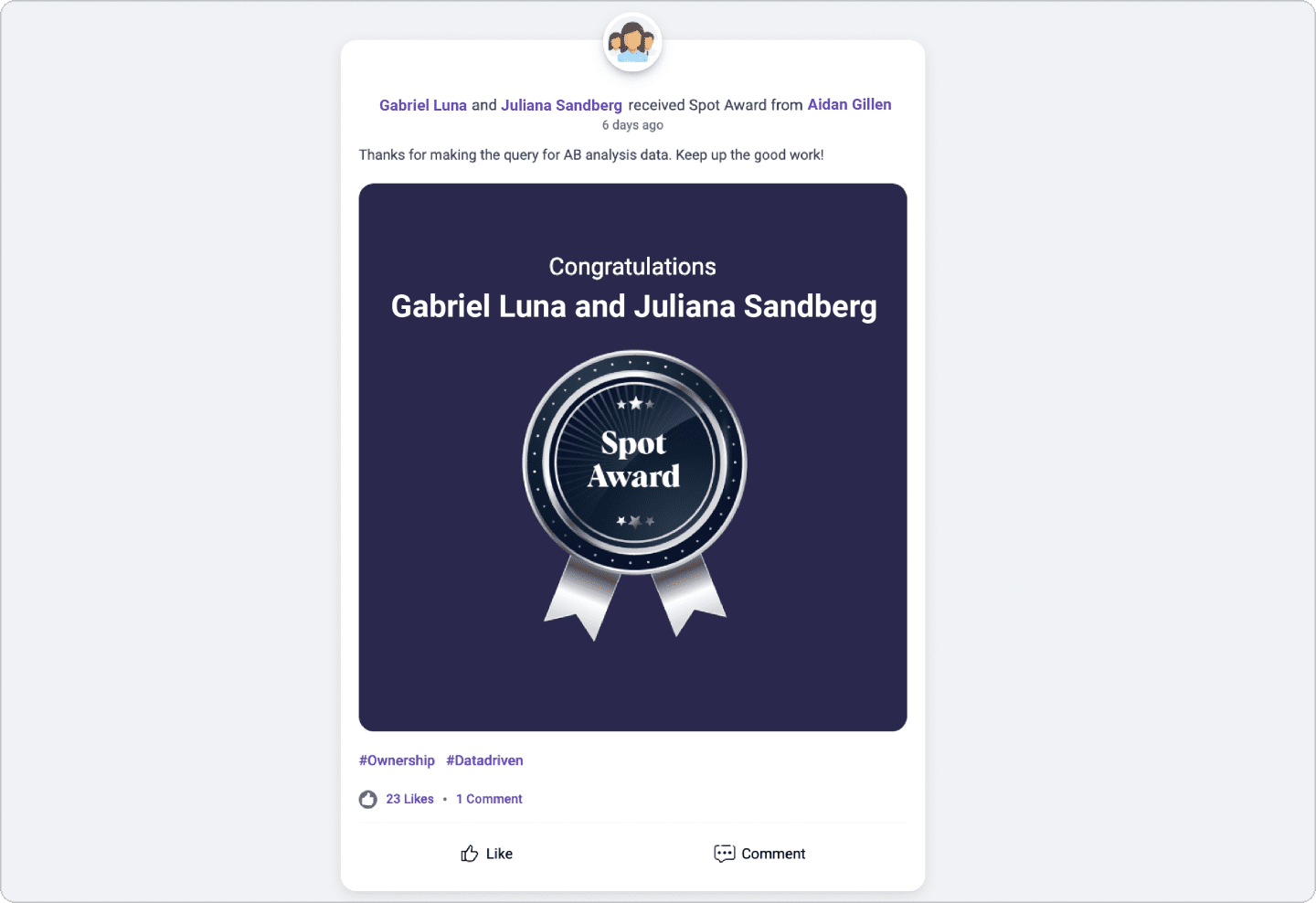
Relationship-oriented leaders in moderately structured situations need recognition that strengthens connection. Peer-to-peer recognition and a social recognition feed that makes appreciation visible across the organization reinforce the relational fabric this style depends on.
Autonomous teams in Leadership Substitutes contexts need recognition that maintains culture without requiring active leadership presence. Core Values Alignment awards, where peer recognition is tagged to company values, reinforce desired behaviors organically without micromanagement.
Advantages and Limitations of Contingency Leadership Theory
No framework deserves uncritical adoption. Here is an honest assessment of what contingency theory gets right and where it falls short.
Advantages
Contingency theory works because it mirrors how organizations actually function. No two teams are identical. No two leaders operate in exactly the same context. A framework that accounts for this variability will always outperform one that prescribes a single approach.
Specifically, contingency theory:
- Accounts for situational complexity rather than prescribing a one-size-fits-all approach
- Is backed by decades of empirical research across multiple models and organizational contexts
- Provides specific, testable predictions about leadership effectiveness, not just broad principles
- Applies across industries, company sizes, and organizational cultures
- Encourages leaders to analyze context before acting, building more reflective leadership habits
- Legitimizes different leadership styles for different situations, which reduces the unproductive anxiety of "what is wrong with my approach?" when the real issue is fit
Limitations
Contingency theory is also genuinely difficult to use in practice. Its limitations are worth understanding clearly, because they determine when and how to apply it effectively.
Some models assume leadership style is fixed. This creates direct tension with developmental approaches. If Fiedler is right, leadership coaching matters less than leadership placement. If Hersey and Blanchard are right, the opposite is true. In practice, both have merit. The question is which assumption fits the specific leader and context you are working with.
Real-time applications are harder than they look. Leaders usually cannot stop during a conversation to analyze the situation using a framework. These models are most helpful for preparing in advance, not “in the moment.”
Limited guidance on developing flexibility. Most contingency models describe the fit between style and situation well. But they do not explain how to expand a leader's range. They diagnose the problem. They do not always prescribe the development path.
Cultural bias. Nearly all of these models were developed in Western organizational contexts between the 1960s and 1980s. Their situational variables reflect assumptions about authority, communication, and individual agency that do not hold universally. Applying them to global or multicultural teams requires deliberate adaptation.
How to Mitigate Limitations
- Use models as preparation tools, not in-the-moment scripts
- Prioritize well-researched models: Fiedler, Hersey-Blanchard, Path-Goal
- Use data (eNPS, engagement analytics) rather than intuition
- Adapt situational variables explicitly for cultural context
- Complement Fiedler with developmental models like Situational Leadership
- Pair contingency assessment with leadership coaching programs
Contingency Leadership Theory vs. Other Leadership Theories
Contingency theory does not exist in isolation. Most organizations are already using other leadership frameworks alongside it, whether consciously or not. Understanding how contingency theory relates to those frameworks helps leaders and HR professionals know when to use which lens.
| Theory | Core Premise | Leader Flexibility | Situational Focus | Best Application |
|---|---|---|---|---|
| Contingency Theory | Effectiveness depends on leader-situation fit | Varies by model | Central focus | Matching leaders to contexts and decisions |
| Transformational Leadership | Leaders inspire and elevate followers beyond self-interest | High — learned behaviors | Low — applies universally | Driving organizational change and vision alignment |
| Servant Leadership | Leaders serve followers first | Moderate | Low — philosophical approach | Building trust-based, people-centered cultures |
| Trait Theory | Leaders are born with certain innate qualities | None — traits are fixed | None | Identifying leadership potential in selection |
| Behavioral Theory | Leadership is a set of learnable behaviors | High — trainable | None — seeks one best way | Designing leadership training programs |
| Transactional Leadership | Leaders use rewards and punishments to motivate | Low — exchange-based | Low | Performance management and compliance-driven environments |
The key distinction is this. Most leadership theories tell you how to lead. Contingency theory tells you when each approach is most appropriate.
Summing up: Leading Effectively Means Leading Contextually
The most effective leaders are not the ones with the most polished style. They are the ones who read the situation accurately and adapt.
That skill has always mattered. Especially today.
Remote work, AI-driven role changes, and globally distributed teams mean the situational variables leaders navigate today are more numerous and volatile than anything Fiedler or House could have anticipated. Their core insight still holds. There is no one best way to lead. But the range of situations requiring that adaptability has expanded significantly.
For CHROs and organizational decision-makers, contingency theory offers a practical gift. A shared language that moves leadership conversations away from personality and politics toward fit, context, and measurable outcomes. When a leader struggles, the first question should not be "what is wrong with this person?" It should be "is this person in the right situation?"
That single reframe can transform how your organization approaches leadership development, succession planning, and team design.
Frequently Asked Questions
What is the contingency theory of leadership?
The contingency theory of leadership states that no single leadership style works in every situation. Effective leadership depends on matching a leader's approach to situational factors like task structure, team readiness, and organizational context. It originated with Fred Fiedler's 1964 model and has since expanded into 7 distinct frameworks.
What are the main contingency leadership models?
The 7 main contingency leadership models are: Fiedler's Contingency Model, Hersey and Blanchard's Situational Leadership Theory, House's Path-Goal Theory, the Vroom-Yetton-Jago Normative Decision Model, Kerr and Jermier's Leadership Substitutes Theory, Fiedler and Garcia's Cognitive Resource Theory, and Yukl's Multiple-Linkage Model. Each addresses a different dimension of leader-situation fit.
What is Fiedler's contingency model of leadership?
Fiedler's model classifies leaders as task-oriented or relationship-oriented using the LPC scale, then evaluates three situational variables — leader-member relations, task structure, and position power — to determine which style fits best. Its core insight is that leaders should be matched to situations that suit their natural style rather than expected to change.
How is contingency theory different from situational leadership?
Contingency theory is the broad family of frameworks. Situational leadership is one model within it. The key difference: Fiedler says style is fixed so change the situation, while Hersey and Blanchard say leaders can and should adapt their style to match follower readiness.
How do you apply contingency theory in the workplace?
Assess the leader's natural style, evaluate the situation across task structure and team readiness, select the most relevant model, then measure results through engagement data and recognition metrics. The key shift is from intuition to data — use eNPS scores and pulse surveys to assess fit continuously.
Why is contingency theory important for HR leaders?
Contingency theory moves HR away from generic competency models toward context-specific leadership assessment. It reframes difficult conversations — when a leader struggles, the question becomes "is there a situation mismatch?" rather than "is this a bad leader?", opening up more constructive solutions.
Which contingency model is best for remote teams?
No single model is best, but Path-Goal Theory and Situational Leadership are most applicable since remote work increases task ambiguity and makes trust harder to build. According to Gallup, hybrid employees have the highest engagement rates at 35%, and manager quality is a significant factor in that gap.

This article is written by Nilotpal M Saharia. Nilotpal M Saharia is a Senior Content Marketing Specialist & R&R Strategist at Vantage Circle, with 7 years of expertise in marketing, HR, and content strategy.
Connect with Nilotpal on LinkedIn.