You walk into any office today, and you'll notice something in that work environment.
Some people are just doing their work for the sake of it and others? They're all in.
A Gallup study found that employee engagement hit a ten-year low in late 2024, with only 31% of U.S. workers truly engaged. That is not even half of the workforce, which is a big problem. That too a big one.
Disengaged employees cost companies billions. They miss deadlines. They don't innovate. They do the bare minimum.
But engaged employees? That’s a completely different story.
They care about their work. They take initiative. They make teams better with a positive approach.
So, what separates them from everyone else?
This guide breaks down the real characteristics of engaged employees in 2026. Not corporate jargon. Just the actual traits that matter.
Because once organizations know what to look for, everything changes.
Let's jump in.
What Is an Engaged Employee?
Let's understand the simplest explanation about who these engaged employees are.
An engaged employee is enthusiastic about their work, driven to achieve the organizational goals, and injects motivation in the workplace. They care about the organization, and the paycheck becomes secondary for them.
Gallup describes them as psychological "owners" who drive performance and innovation. They take initiative. They solve problems. They push things forward.
On the contrary, disengaged employees do bare minimums. They are not invested in their work and are psychologically detached from the workplace.
According to Gallup’s State of the Global Workplace report, in 2024 alone disengagement cost the world economy a whopping $438 billion.
The same report suggests that if the workplace was fully engaged $9.6 Trillion worth of productivity could be added to the global economy.
The difference shows up everywhere.
What creates this kind of engagement? It's simpler than most think. It is the sense of purpose and belonging that an employee wants. This Gallup data perfectly fits in here as it suggests that employees with a strong sense of purpose at work are 5.6 times more likely to be engaged.
When people see how their work makes a difference, everything changes.
20 Key Characteristics of Highly Engaged Employees
Structured across 5 trait categories — click any card to read the full description.
⚡ Performance-Driven 5 🧠 Behavioral 5 🤝 Team & Culture 5 📈 Growth-Oriented 3 ❤️ Brand & Loyalty 3
Performance-Driven Traits
Traits 1–5 of 20
01 🎯
Focused on Work Outcomes
One of the most important traits or signs of an engaged employee is that they are focused on what they do.
They are attentive and are keen to take up challenges. On top of that, they are enthusiastic and are more eager to learn new things which will keep them on top of their game. This is because they feel it is the perfect work environment for them and that they are acknowledged for their work.
▾
02 🏆
Takes Ownership and Accountability
Ownership is about taking responsibility of the work that one is assigned.
Employees that are engaged stand by their decisions and actions, embracing both praise and blame, when things go wrong. They view mistakes as chances for growth and are dedicated to doing things right. Doing so enables them to become better individuals and improve their skills in the long run. Moreover, it also assists the organization to create a workforce that is dependable and trustable.
▾
03 ✅
Low Error Rates
Employees with high levels of engagement are more likely to grasp their work and job responsibilities quickly.
This allows them to focus more on details, comprehend the procedures involved, and ultimately reduce error. With lower errors, they produce high-quality work which positively impacts the organizational bottom-line.
▾
04 🧗
Seeks Challenges
Challenges aren't deterrents for engaged employees; they're opportunities.
They embrace challenging activities with excitement, seeing them as opportunities to demonstrate their abilities, contribute effectively, and advance in their positions.
▾
05 🚀
Goes the Extra Mile
"Good enough" is never good enough for engaged employees. They want more than that.
It's not about longer hours.
It's about caring enough to make things right.
This separates average from exceptional.
They see what's required to complete the job and do the needful without any reminders. On top of that they help struggling teammates to finish projects and find better solutions.
18%Productivity jumps in highly engaged workforces. That extra effort compounds fast. — Gallup
▾
Behavioral Traits
Traits 6–10 of 20
06 ☀️
Positive Attitude
Engaged employees bring energy to work. They don't complain constantly and drag the team down.
Instead, they tackle problems with optimism. Bad days happen and challenges arise but their default isn't negativity. This attitude is contagious. Teams with engaged employees simply feel different. They have better morale and instill stronger collaboration along with resilience.
70%Gallup's meta-analysis: highly engaged teams report up to 70% higher well-being compared to less engaged teams.
▾
07 💪
Self-Confidence
Engaged employees have a clear understanding of what their job requires from them.
They acknowledge their strengths and try to work on their weaknesses. These employees are skilled and capable that gives them the confidence to perform exceptionally. Moreover, they have a positive attitude and approach while starting any project or task. They strategize well and have a firm belief that things will work out in their favor. This allows them to motivate themselves and others as well to attain organizational goals.
▾
08 ⏰
Disciplined
A significant sign of an engaged employee is that they are disciplined in every aspect of their work.
They have a proper attitude, respect others, maintain their schedule, and complete their work in the given time frame. When your employees are disciplined, it becomes easier for a manager to delegate a task without any hassle. They know what is expected of them and how they can help the organization excel in the present market.
▾
09 2026 Insight 🔄
Adaptable to Change
Change doesn't scare engaged employees.
New systems? They learn them.
Shifting priorities? They adjust.
Unexpected problems? They pivot.
They see change as growth, not disruption. While others resist, they adapt. In 2026, this matters more than ever. Markets shift fast. Technology evolves constantly. Companies need people who can keep up. Engaged employees don't just keep up. They help others navigate change too.
▾
10 🔍
Curious and Asks Questions
Employees who are engaged are often curious about newer developments and have a positive lookout.
They raise questions that help them assess the situation in a better way. This gives them the opportunity to come up with new ideas and enhance their skills with the growing changes.
▾
Team & Culture Traits
Traits 11–15 of 20
11 💬
Communicates Effectively
Highly engaged employees communicate effectively to make the best use of time.
They collaborate with others and provide clear cut information so that there is always a smooth flow of work. Moreover, they listen to others and respect their viewpoint. When there is a clear flow of communication among employees, there are fewer conflicts and increased productivity. It is because every employee understands what their role is and have a clear vision of what they need to do. Thus, enhancing engagement and boosting morale in the long run.
▾
12 🧩
Collaborates Openly
Employees that are engaged are always open to collaborating with others.
They believe in teamwork and desire to achieve success without any shortcomings. With the help and assistance of different people, these employees help increase the workforce's productivity and performance. Moreover, collaboration makes it possible for employees to experiment with new ideas. People from different backgrounds will provide a broader perspective on things that need to unfold. This further helps them to innovate and develop processes to accomplish their objectives.
▾
13 🔗
Builds Strong Relationships
Employees who are engaged realize the value of networking and collaboration.
They aggressively seek connections with their peers, supervisors, and even colleagues from other departments. This isn't simply for personal gain; by developing strong professional ties, they may collaborate more efficiently to achieve mutual goals.
▾
14 🛡️
Supports Teammates
Employees who are engaged are not only concerned with their work, but they help others as well.
For them, the prime objective is to achieve success for the organization. And when they see someone struggling with their work, they provide a helping hand. This not only boosts employee morale but also increases team bonding. Hence, creating a positive work culture where employees look out for each other.
▾
15 🎓
Mentors Others
Employees that are engaged look for opportunities to give back.
They accomplish this in part by mentoring less experienced colleagues, sharing their knowledge, and providing assistance. Moreover, this enables them to become good leaders and help new employees get acquainted in the new work setting. This benefits not only the mentee but also the team and organization.
▾
Growth-Oriented Traits
Traits 16–18 of 20
16 📚
Always Open to Learning
Employees that are always engaged have the eagerness to learn every day.
They make it a habit to learn and relearn new things continuously. On the other hand, they encourage others as well to discover new ways to work. This way, they open endless opportunities to become proficient in their job. Moreover, it allows them to gain experience through which they can leverage their skillset.
▾
17 🌱
Actively Seeks Development
Engaged employees want to grow and take training seriously.
They don't wait for growth to come to them.
They chase it.
They ask for feedback and volunteer for new projects to upskill themselves. Stagnation isn't in their vocabulary as they're always looking for the next skill to master. Employees become engaged when they have opportunities to learn and grow. It's a two-way street. Companies invest in development, and employees invest back with better performance. These are the people attending workshops, reading industry articles, and asking how to improve.
▾
18 🎯
Aligns Personal & Professional Goals
Employees with high levels of engagement can align their personal and professional goals.
They know how to balance their work without reducing productivity. Their main goal is to achieve all the targets without wasting time. Moreover, aligning their goals lets them see a clear picture of what they want to achieve in the future. When they understand their main objective, they start planning and take steps to accomplish them. And as a leader, you need to support and guide them. With your mentorship, they will be able to pave the correct path and achieve good satisfaction levels.
▾
Brand & Loyalty Traits
Traits 18–20 of 20
18 📢
Advocates for the Company
Engaged employees often act as brand ambassadors for the company.
They advocate for the company and talk positively about the workplace on social media platforms. This enables the company to attract promising candidates and cultivate a strong brand image within its desired audience.
▾
19 🎉
Celebrates Achievements
Engaged employees are always willing to push others to do well in their job responsibilities.
They celebrate every little accomplishment which works as a great morale booster. In the long run, it helps in enhancing the productivity of the workforce and creates good camaraderie among each other.
▾
20 🏡
Stays Longer with the Organization
Engaged employees stick around because they love their job and the organization they work for.
High turnover kills teams.
Engaged employees build them instead.
They're not constantly browsing job boards or updating their resumes every few months. They're building careers, not just filling time. With lower turnover rates, there are fewer recruitment costs, less training time, and retention of institutional knowledge. These employees stay because they're valued and because the work matters to them. Moreover, they see a future worth investing in which is crucial for their growth.
51%Turnover drops by 51% when employees are highly engaged — a massive number.
▾
← Prev
Next →
What Are the Key Indicators of a Highly Engaged Workforce?
It’s easy to spot the employees who are engaged as there are signs that show up. It can be across behavior, performance, culture, and customer interactions.
Here is what you need to watch for.
1. Behavioral Indicators
The daily action of employees reveals their engagement levels within the organizations. You can check for these behavioral patterns in the workplace:
- Employees take initiative while aligning the tasks with the organizational goals.
- Communication flows openly and effortlessly across teams.
- Quick adaptation to new changes and processes without any resistance.
- Consistent motivation even during tough periods with a positive mindset.
- Strong accountability for outcomes and acknowledge any errors.
2. Performance Indicators
Engaged employees deliver results differently as their output speaks louder than the words.
- Productivity levels exceed organizational benchmarks.
- Teams regularly hit or surpass targets without missing deadlines.
- Error rates stay minimal or negligible.
- Continuous improvement and learning become the norm.
3. Cultural Indicators
The good thing about engagement is that it shapes the entire organizational culture. With high morale and productivity, the outcomes are positive, which itself speaks a lot about the work environment.
- High trust between employees and leadership
- Strong alignment with company values
- Frequent peer and manager recognition
- Psychological safety in sharing ideas
4. Customer Impact Indicators
Engagement is contagious, and it doesn't stay internal. The ripples of engagement can be seen outward to every customer interaction.
- Higher customer satisfaction scores when engagement is high.
- Stronger brand loyalty and repeat business as customers like their overall experience.
- Fewer customer complaints with higher query resolution.
- Better brand perception in the market.
- Improved customer retention rates.
What Three Things Do Engaged Employees Have in Common?
Have you ever wondered how some employees are different from others? What really sets them apart?
It is not always about skills or overall experience. Sometimes there is something deeper connected to it.
Below are three things that engaged employees share.
1. Emotional Commitment
When was the last time someone genuinely cared about a project at work? Think about it.
If someone really did care, then that's emotional commitment right there.
Engaged employees don't just show up at work. They show up invested. They care about the team. They care about the outcome. That is how they operate.
That is all engagement is all about. It is the emotional and psychological connection employees feel toward their work, their team, and the organization. And with real engagement, it changes everything about how someone works.
2. Discretionary Effort
The interesting thing about engaged employees is that nobody asks them to go above and beyond. They just do it naturally.
They are willing to do the extra task and stay longer to get things right. Moreover, they help their colleagues, boost morale, and encourage others to learn from their mistakes.
As per Gallup, engaged employees achieve 23% higher profitability. And a big chunk of that comes from these small, everyday moments that nobody really tracks. But they add up.
3. Alignment with Purpose
Every employee wants their work to mean something. And that is where the difference comes in.
Employees who are engaged feel that as they look at what they do every day and see how it fits into something bigger.
This makes their task more meaningful and purposeful.
As mentioned earlier, employees with a strong sense of purpose are 5.6 times more likely to be engaged. Honestly, that number itself says a lot about engaged employees.
Once someone truly connects with why they do what they do, everything clicks into place.
How to Measure Employee Engagement Effectively
You know what’s not rocket science? Measuring engagement. However, doing it right? That takes a little thought.
To make things easier, here is a list of things that organizations can follow to measure it.
- Run employee engagement surveys: This is the go-to method as it is simple, scalable, and effective when done right.
- Use pulse surveys: These are short, and frequent check-ins to track how employees feel in real time.
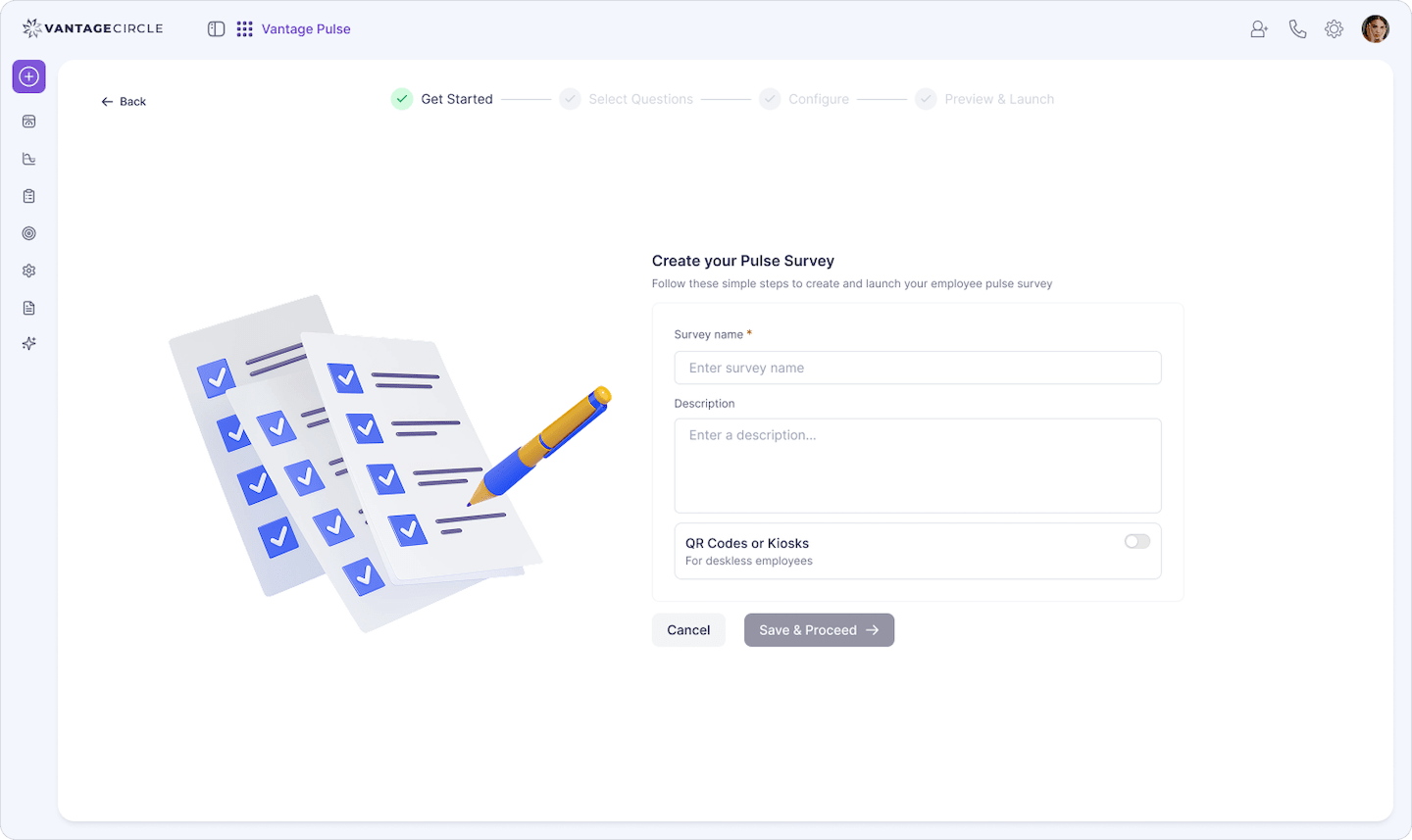
Figure: The image is an insight of the dashboard where you can create surveys as per your requirements.
(Source: Vantage Pulse)
- Conduct stay interviews: Ask employees about the reasons behind their long tenure with the organization and why they stay. The answers are gold.
- Track turnover rates: If there is high turnover, then it’s a signal of disengagement. The numbers don't lie.
- Monitor absenteeism: Track the rate of absenteeism within the organization. If there are too many missed days, then there is something off.
- Measure eNPS (Employee Net Promoter Score): If your employees recommend this workplace to others or recommend it on social media, then it says a lot about the engagement levels.
- Hold one-on-one check-ins: One-on-one conversations reveal the real issues without any bias or fear of judgement. Try it with your struggling team members.
- Analyze performance reviews: If there is consistent strong performance within the organization, then it usually means there is strong engagement.
- Track participation in company initiatives: When there is engagement in the workplace, participation rates in company initiatives are high. Engaged employees always show up for everything.
- Use sentiment analysis: AI tools now have the capability to pick up how employees actually feel through their feedback. Use it wisely and transform your workplace.

Figure: The above image gives a total insight of sentiment analysis and breaks it down for you.
(Source: Vantage Pulse)
Use these measurement techniques to transform your work culture that attracts employees to work for you. It's a necessity in this competitive market.
Conclusion!
Engaged employees aren't born. They're built through the right environment, purpose, and culture.
The 20 characteristics covered in this guide aren't a checklist to memorize. They're signals to watch for, nurture, and develop across your workforce. From taking ownership to mentoring others, from adapting to change to advocating for the brand, each trait compounds over time.
The data is clear. Engaged teams are more productive, more profitable, and more loyal. In a world where only a few percentage of workers are truly engaged, the organizations that prioritize these traits will have a serious competitive edge.
Start small. Recognize the engaged employees you already have. Create conditions where more people can become them.
Because when your people are all in, your organization is unstoppable.
FAQs
Q1. What are the most important characteristics of engaged employees?
A. The most critical characteristics include taking ownership, going the extra mile, effective communication, adaptability, and aligning personal goals with organizational purpose. Engaged employees consistently show emotional commitment and discretionary effort across all of these areas.
Q2. How do engaged employees differ from disengaged ones?
A. Engaged employees take initiative, collaborate openly, and care about outcomes beyond their job description. Disengaged employees do the bare minimum, show little emotional investment, and are psychologically detached from their work. This gap costs organizations heavily in lost productivity and higher turnover.
Q3. Can employee engagement be measured?
A. Yes. Organizations can measure engagement through pulse surveys, eNPS scores, stay interviews, absenteeism tracking, turnover rates, and performance review analysis. Using a combination of these methods gives the most accurate picture of where your workforce actually stands.
Q4. What drives employee engagement in 2026?
A. Purpose, belonging, and growth opportunities are the biggest drivers. Employees who understand how their work contributes to larger organizational goals, feel psychologically safe, and have clear development paths are far more likely to stay engaged over the long term.
Q5. Why is it important for organizations to identify engaged employees?
A. Because it directly impacts the bottom line. Highly engaged workforces report 23% higher profitability and 51% lower turnover. Identifying and nurturing engaged employees helps retain top talent, reduce recruitment costs, and build a culture where others want to show up and do their best work.

This article is written by Mrinmoy Rabha. Mrinmoy Rabha is a content writer and digital marketer at Vantage Circle. He is an avid follower of football and passionate about singing