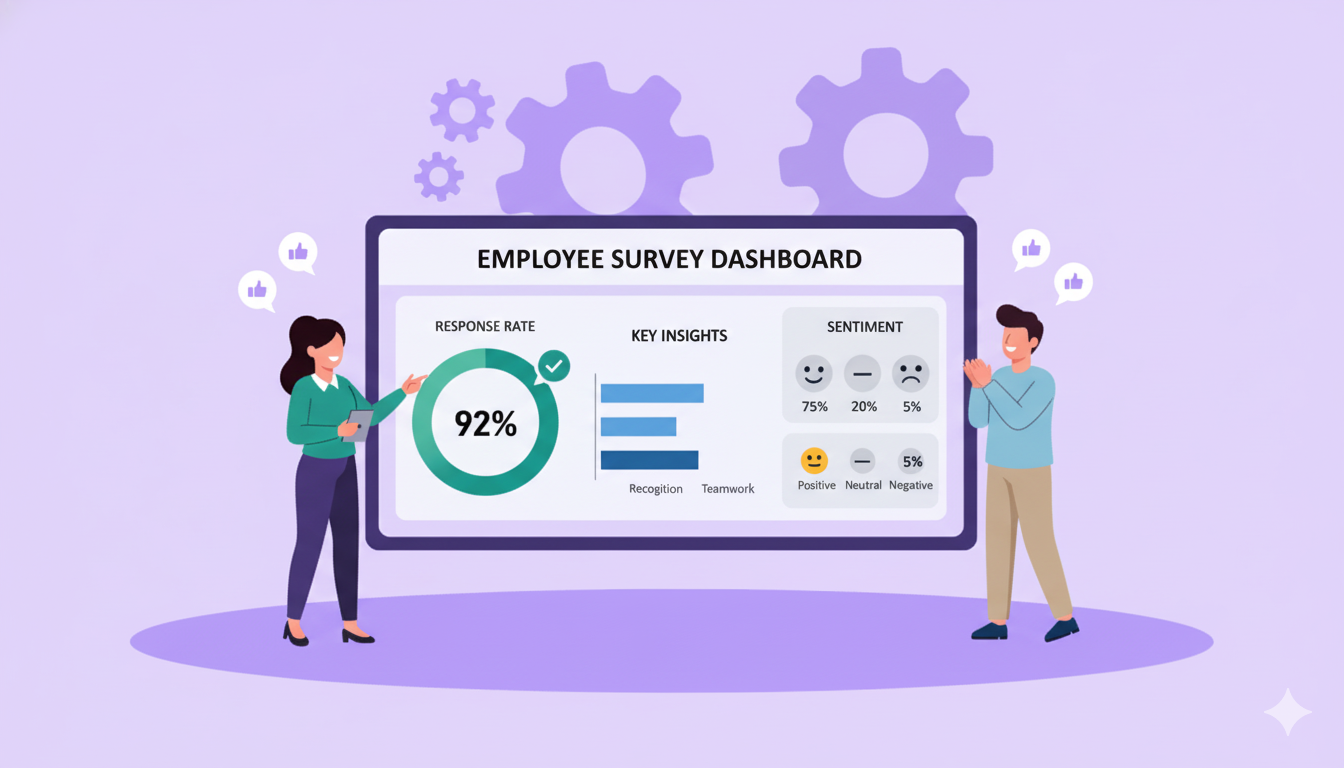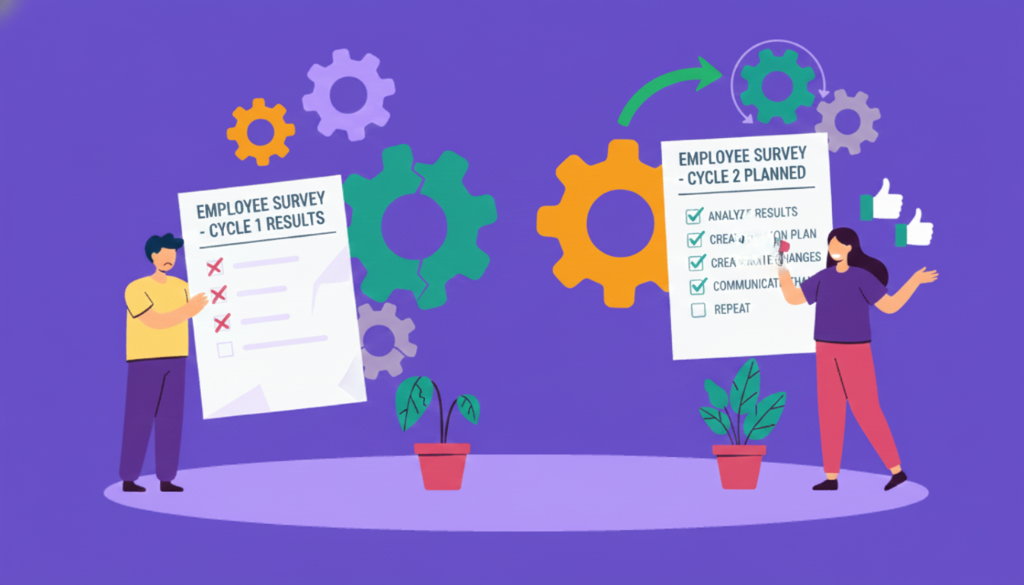

Picture this: you run a big annual survey each December to measure employee engagement. By the time you analyse results in February, the data is already two months old. You create an action plan, but by June, half the issues have either resolved themselves or gotten worse.
Sound familiar? This is the problem pulse surveys are built to solve.
TL;DR: A pulse survey is a short, recurring employee questionnaire (5–15 questions) that gives HR leaders real-time data on engagement, morale, and team health. The best pulse programmes combine high anonymity, automated scheduling, and fast follow-through — achieving participation rates above 60% and eNPS scores that predict retention before resignations happen. Run them monthly at minimum. Act on results within two weeks.
What Is a Pulse Survey?
A pulse survey is a short, frequently recurring employee questionnaire — typically 5 to 15 questions — designed to measure engagement, sentiment, and team health in real time rather than once a year.
Unlike annual engagement surveys that capture a single yearly snapshot, pulse surveys run on a rolling schedule: weekly, bi-weekly, or monthly. They capture how employees feel right now, not how they felt six months ago when your last annual survey closed.
Think of it as taking your organisation's temperature continuously, rather than once a year when it is already too late to prevent the fever.
What Pulse Surveys Are Not
A pulse survey is not a manager check-in, a one-off form, or an ad hoc feedback request. It is an automated, anonymous, recurring programme with structured reporting. The data aggregates across teams and departments, revealing patterns that no individual conversation would ever surface.
Pulse Surveys vs Annual Employee Surveys: Key Differences
Both approaches have a role in a complete listening strategy. Here is how they compare across the factors that matter most to HR leaders:
| Factor | Pulse Survey | Annual Survey |
|---|---|---|
| Length | 5–15 questions | 50–100+ questions |
| Completion time | 2–10 minutes | 30–60 minutes |
| Frequency | Weekly, bi-weekly, or monthly | Once per year |
| Data freshness | Real-time | 12-month lag |
| Time to action | Days to weeks | Months |
| Participation rates | Typically higher (short format) | Often lower |
| Best for | Trend tracking, early warnings | Deep culture assessment |
| Analytics depth | Heatmaps, segment filters, eNPS trend | Comprehensive benchmarking |
The smart approach is not either/or. Use pulse surveys for ongoing monitoring and early warning. Use annual surveys for the deep-dive culture assessment you run once a year. Together, they give you a complete picture.
8 Reasons Pulse Surveys Are Non-Negotiable in 2026
1. Real-Time Early Warning Before Disengagement Becomes Resignation
By the time disengagement appears in an annual survey, it has already been costing you for months. Gallup estimates that actively disengaged employees cost US businesses $483 billion to $605 billion per year in lost productivity.
Pulse surveys surface warning signs — a drop in Relationship with Manager scores, a spike in Compensation concerns — while there is still time to act.
2. Employees Want to Be Heard More Than Once a Year
IBM research shows that 83% of employees say they would participate in an employee listening programme. But participation only stays high when employees believe their feedback leads to real change. The short cycle of a pulse programme makes that credible in a way a once-a-year survey never can.
3. Higher Participation Rates Than You Expect
Shorter surveys get completed. A five-question pulse survey takes under two minutes. AccessOne, a US healthcare technology company, achieved a 67% participation rate in their first month of structured pulse surveying — more than double the industry benchmark of 30 to 50%.
4. Segment-Level Signals That Averages Hide
A company-wide engagement score of 72 looks healthy until you filter by department. Heatmap views reveal where a score of 20 out of 100 in "Relationship with Peers" is hiding inside a team that looks fine on the surface. Without segment-level data, that signal is invisible.
5. Employees Who Feel Heard Perform Better
Salesforce research finds that employees who feel their voice is heard are nearly five times more likely to feel empowered to perform their best work. Regular pulse surveys send a clear signal: leadership is listening, not just once a year, but continuously.
6. eNPS as a Leading Indicator for Retention
Employee Net Promoter Score (eNPS) is one of the strongest predictors of voluntary turnover. Tracking it monthly gives HR leaders a leading indicator rather than a lagging one. AccessOne's eNPS reached 45 after implementing a structured pulse programme — well above the industry average of 10 to 30, with Promoters at 58%, Passives at 29%, and Detractors at 13%.
7. Data Executives Can Actually Use
C-suite leaders need culture data they can act on, not a once-a-year report. Monthly pulse data, segmented by department and business unit, gives executives the same real-time insight into their people that they already expect from their sales and finance dashboards.
8. Measurable ROI on People Initiatives
When you run a wellbeing programme or a manager training cohort, how do you know it worked? Pulse surveys let you measure before and after in near real time, using the same employee population. According to Gallup, employees in high-engagement business units show a 78% decrease in absenteeism and a 70% improvement in wellbeing.
How to Create an Effective Pulse Survey: 6 Steps
Step 1: Define one clear objective. Are you measuring general engagement, post-restructuring morale, or a specific dimension like psychological safety? One focus per survey run keeps questions sharp and results actionable.
Step 2: Keep it to 5–15 questions. Surveys completed in under 10 minutes produce significantly higher completion and response quality. NIH research confirms that response quality drops markedly above the 10-minute threshold. Always display an estimated completion time in the survey itself — it removes the biggest barrier to starting.
Step 3: Mix question types deliberately. Use rating scales (1 to 5) for trackable metrics, open-ended questions for qualitative insight, and yes/no only for factual items. Avoid making every question open-ended — it kills completion rates.
Step 4: Guarantee anonymity and say so inside the survey. The Journal of General Internal Medicine found that anonymous surveys achieve response rates of 56 to 63%, compared to much lower rates for identified surveys. Displaying a trust statement inside the survey itself — not just in the invitation email — materially increases honest responses.
Step 5: Build the action process before you launch. The most common reason pulse programmes fail is that feedback is collected with no clear owner for acting on it. Assign each category of result (Compensation, Manager Relationship, Wellness) to a specific stakeholder before the first survey goes out.
Step 6: Close the loop publicly after every cycle. Teams that see their feedback reflected in leadership communications are far more likely to keep participating. Share headline results with the whole organisation — even when the news is uncomfortable.
7 Pulse Survey Best Practices That Drive Results
Run surveys on a fixed schedule. Irregular cadences erode trust. If employees expect a survey on the first Monday of the month, stick to it without exception.
Keep 70–80% of questions consistent across cycles. Changing questions each time makes trend analysis impossible. Use the remaining 20 to 30% for topical additions tied to current priorities.
Always segment before presenting results. Never lead with a company-wide average. Filter by team, location, tenure, and seniority before drawing conclusions. The average hides the departments that need attention most.
Act within two weeks of each survey close. The faster you respond, the more employees believe their input matters. Even a brief all-hands update — "here is what we heard, here is what we are doing" — maintains credibility and drives participation in the next round.
Train managers on their own team-level data. Pulse data is most valuable at the team level, not the company level. Managers who receive their own scores and know how to discuss them drive the highest participation rates in subsequent cycles.
Enable two-way anonymous follow-up. When an employee raises a concern in an open-ended response, HR should be able to reply anonymously to gather more context. This turns a survey tool into a genuine listening culture.
Benchmark against industry norms. Knowing your eNPS is 30 means nothing without context. Understand your sector benchmarks (industry eNPS average: 10 to 30) and set improvement targets before each new programme cycle.
How to Measure and Act on Pulse Survey Results
The Four Metrics That Matter Most
Engagement Index — an overall score (0 to 100) that aggregates all category scores. Track month-over-month movement, not just the absolute level. A score climbing from 62 to 65 over three months is a stronger signal than a static score of 75.
eNPS — Promoters minus Detractors, expressed as a number from -100 to +100. Above 20 is considered good for most industries. Above 40 is excellent. Watch for downward trends more than single-month readings.
Participation Rate — the percentage of employees who completed the survey. Below 50% means your data may not represent your full workforce. Above 65% is strong. Track this as a health metric for the programme itself.
Category Scores — drill into individual dimensions: Relationship with Manager, Wellness, Recognition, Communication, Work-Life Balance. The category data is where the actionable insight lives.
Using Heatmaps to Find What Averages Hide
The highest-impact finding from any pulse programme is usually a specific team in a specific location with a category score below 40. Without a heatmap that cross-tabs department against category, that signal is buried in company-wide averages.
Filter your heatmap by department, country, business unit, and tenure. The most critical scores — the ones that predict attrition — are almost never visible at the top level.
Building an Action Plan That Sticks
After each survey, assign a named owner to every low-scoring category. Set a 30-day target score improvement. Review against the target in the next survey cycle. This structured loop transforms pulse data from a reporting exercise into an actual management system.
See how it works in practice: Vantage Pulse automates the full cycle — survey scheduling, heatmap segmentation, AI-generated response suggestions for HR, and action planning — in one dashboard. Book a 15-minute demo and see the difference.
Common Pulse Survey Mistakes to Avoid
Surveying without a commitment to act. Employees who complete a pulse survey and see no visible response stop completing future surveys. Response rates drop fast and rarely recover. Survey only when you have the capacity to act.
Changing questions every cycle. You cannot track trends if the questions change. Treat your core question set as fixed infrastructure.
Reporting only company-wide averages. Aggregate scores mask the teams that are struggling. Always segment before sharing results.
Ignoring open-ended responses. Quantitative scores tell you what is happening. Open-ended comments tell you why. Read every comment — or use AI sentiment analysis to surface themes at scale.
Skipping the communication step. A survey result shared only with the HR team has zero culture impact. Make results visible.
FAQ
What is a pulse survey? A pulse survey is a short employee questionnaire (5–15 questions) sent on a recurring schedule to measure real-time engagement, morale, and team health. Unlike annual surveys, pulse surveys provide continuous data that HR leaders can act on within days of each cycle closing.
How often should pulse surveys be conducted? Most organisations run pulse surveys monthly or bi-weekly. Monthly cadences give HR time to analyse results and act before the next survey. Weekly surveys work for fast-moving teams but require a dedicated action process to prevent survey fatigue.
Are pulse surveys anonymous? Yes. Effective pulse surveys collect no name, email, or identifying data. Anonymity is the single biggest driver of honest responses. Display a trust statement inside the survey itself — not just in the invitation email — to maximise participation.
What is a good participation rate for a pulse survey? The industry benchmark is 30 to 50%. Above 60% is strong. AccessOne achieved 67% participation in their first month — more than double the benchmark — by keeping the survey short and sharing results promptly with all employees.
How do pulse surveys differ from annual engagement surveys? Pulse surveys are short (5–15 questions), frequent, and built for fast action on specific themes. Annual surveys are comprehensive (50–100+ questions) but create a 12-month data lag. Most HR leaders use both: pulse surveys for ongoing monitoring, annual surveys for deep culture assessment.
Conclusion
Pulse surveys work when they are short, consistent, anonymous, and acted on quickly. The data is only as valuable as the speed at which your organisation responds to it.
Most companies find out about disengagement when someone hands in their notice. A well-run pulse programme catches it 90 days earlier — in the category scores, the open-ended comments, the departments where participation is quietly falling.
If you are still running one survey a year and wondering why engagement scores feel disconnected from reality, start with a single monthly pulse. Five questions. Two minutes. Consistent timing. Act on results within two weeks. The insights will be immediate, and so will the impact on employee sentiment and retention.
You cannot fix what you do not hear in time.