
If I look back a few years to the early days of my career, I remember that a team charter could get away with three principles: communicate clearly, respect each other, and meet your deadlines. Although they still apply, hybrid work, AI-assisted collaboration, and always-on communication have changed what those principles mean in practice. Teams in 2026 need rules that account for async norms, distributed time zones, and digital-first recognition.
These rules for teamwork are agreed-upon behaviors that govern how team members communicate, make decisions, resolve conflicts, and recognize contributions. Effective rules are specific, measurable, and enforceable. The 10 rules below are used by high-performing teams in 2026 to improve trust, reduce friction, and deliver measurable engagement and performance outcomes.
Here are the 10 enforceable rules:
- Communicate openly and on the record
- Agree on how you disagree
- Meetings have agendas, outcomes, and fewer people
- Recognize contributions weekly, not quarterly
- Roles, owners, and RACI are written down
- Deliver on commitments or renegotiate early
- Diversity of perspective is a rule, not a slogan
- Feedback is specific, timely, and two-way
- Protect focus time and off-hours
- Measure whether the rules are working
What Are Rules for Teamwork?
Teamwork rules are written behaviors that tell a team exactly how to act. Not what to value.
This distinction matters. Because values are aspirational, norms are observed, but rules are enforceable. "We respect each other's time" is a value. "Every meeting has a written agenda sent 24 hours in advance" is a rule. One you can track. One you cannot.
Teams with written rules outperform teams with implicit culture for one practical reason. Written rules eliminate the ambiguity that causes friction. When behavior is ambiguous, people default to their own preferences. Conflict follows.
Written rules also reduce manager load. Instead of adjudicating every disagreement about how decisions get made or who owns a deliverable, the rule handles it.
Start with team-building activities to surface what your team's unwritten rules actually are. Then make them explicit. The 10 rules below give you a tested framework to build from.
The 10 Rules for Teamwork in 2026
Rule 1: Communicate Openly and On The Record
Every team decision, concern, and blocker belongs in a shared channel, not in a private DM.
Private conversations create two-tier teams. Some people get the context. Others do not. Over time, this erodes trust faster than almost any other team behavior.
The Microsoft Work Trend Index 2024 found that fragmented communication is one of the top drivers of productivity loss in distributed teams. Decisions made in side channels may look busy but produce nothing that the broader team can act on.
Practical application:
- Default all project channels to public view
- Maintain a shared decision log per active initiative
- Replace status-update meetings with a posted async standup template
Measurable signal: Percentage of project decisions captured in writing each week.
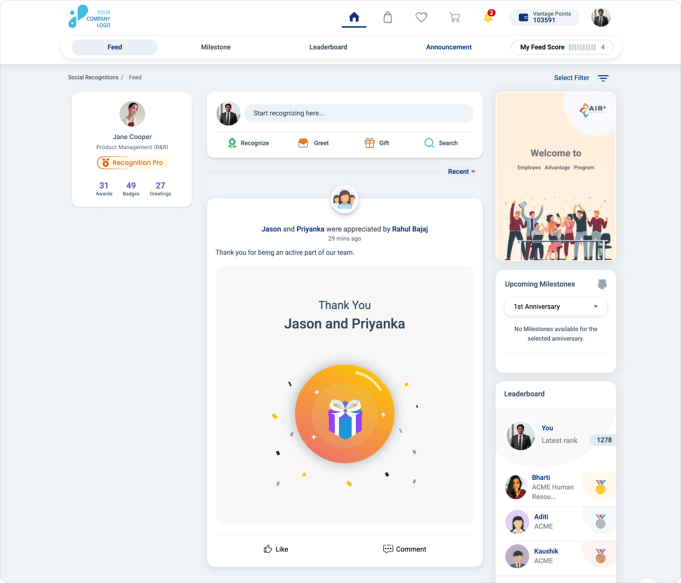
A company-wide Social Recognition Feed gives teams a default-public surface for wins and milestones. It operationalizes rule 1 by making contributions visible to everyone, not buried in one-on-one messages. For more on how open communication drives team results, read our guide to internal communication. Vantage Recognition's Social Recognition Feed is built to make this the team default.
Rule 2: Agree on How You Disagree
Every team needs an explicit conflict protocol written before the first real disagreement.
Google's Project Aristotle, published in 2016, analyzed 180 teams over two years. The single strongest predictor of team effectiveness was psychological safety. Not talent. Not process. The ability to take interpersonal risks without fear of punishment.
A written conflict protocol makes that safety structural rather than personality-dependent.
A three-step protocol used by high-performing teams:
- State the disagreement in writing within 24 hours
- Name the designated decision-maker for this type of call
- Commit to the decision once made, even if you disagreed going in
Measurable signal: A custom Vantage Pulse survey with a psychological safety question (e.g., "I can raise concerns without fear of negative consequences") gives teams a quarterly score they can track over time. A rising safety score indicates this rule is working across the team.
Rule 3: Meetings Have Agendas, Outcomes, and Fewer People
If a meeting has no written agenda and no named decision-maker, it should be a document instead.
Atlassian's State of Teams research consistently shows that workers consider a significant portion of their weekly meetings unproductive. The root cause is almost always the same: no agenda, no owner, no outcome.
The fix is not fewer meetings. It is better-designed meetings.
Three enforceable standards for every meeting:
- Agenda posted at least 24 hours before the scheduled time
- One named decision-owner listed in the calendar invite
- Default meeting lengths of 25 minutes or 50 minutes, never 30 or 60
The 25/50 rule alone reduces calendar fragmentation across the team. Add a "no agenda, no meeting" policy and most status updates migrate to async channels within a month.
Measurable signal: Ratio of decision-producing meetings to status-update-only meetings per week, tracked in a shared calendar or team retrospective.
Rule 4: Recognize Contributions Weekly, Not Quarterly
Recognition delivered close to the contribution drives meaningfully greater engagement than recognition at quarterly or annual review cycles.
Employees who receive timely, specific recognition report higher engagement, lower intent to leave, and stronger peer relationships than those recognized only during formal review cycles. Frequency matters as much as the gesture itself.
Weekly recognition does not require managers to write paragraphs. It requires a low-friction default habit.
Practical application:
- Build a peer shoutout ritual into the weekly team meeting
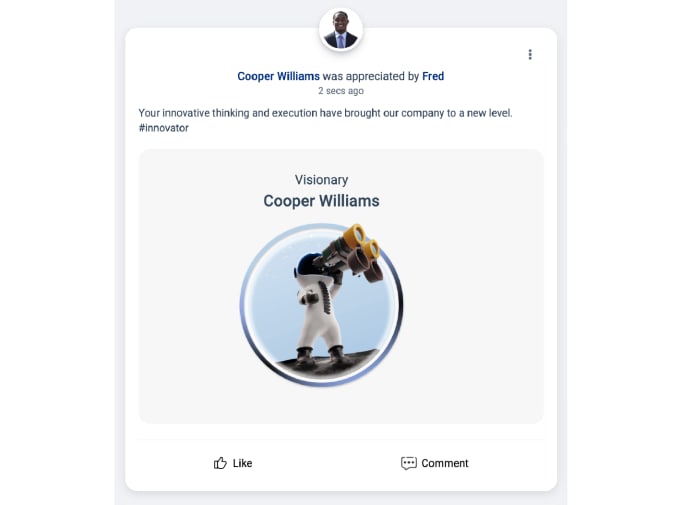
- Use a Peer-to-Peer Recognition module so any team member can send a badge or recognition points the same week the contribution happened
- Set a manager expectation of at least one on-record recognition per direct report per month
Measurable signals: Recognition frequency, percentage of employees recognized in the past 30 days, and manager recognition coverage rate.
Vantage Recognition's Peer-to-Peer Recognition makes the weekly cadence the default rather than the exception. Manager Recognition adds the vertical visibility that peer recognition alone cannot cover.
Rule 5: Roles, Owners, and RACI Are Written Down
Every team responsibility needs one accountable owner, documented where everyone can find it.
Role ambiguity is one of the most common causes of missed deliverables and duplicated effort. Deloitte's 2024 Global Human Capital Trends report identified unclear ownership as a top barrier to team effectiveness. Teams with documented ownership structures consistently outperform teams relying on verbal agreements.
A RACI matrix (Responsible, Accountable, Consulted, Informed) is the standard tool. It does not need to be complex. A four-column document covering the 10 most important team decisions is enough to start.
Three rules for documented ownership:
- Every initiative has one accountable owner, not a committee
- Deputy owners are named for key roles to prevent single points of failure
- Ownership documents are reviewed and updated at the start of each quarter
Measurable signal: Percentage of active initiatives with a named accountable owner documented in a shared, accessible system at any given time.
Rule 6: Deliver on Commitments or Renegotiate Early
Missed deadlines are a communication failure, not a work failure. Renegotiate before the deadline, never after.
The Project Management Institute's (PMI) Pulse of the Profession reports annually that organizations lose significant resources (approximately $2 trillion globally each year) due to poor project performance. A consistent root cause is the gap between what was committed and what was communicated when the commitment became at risk.
The rule is precise: if you know a deadline is at risk, flag it 48 hours before, not after. That window gives the team time to adjust.
Two enforceable behaviors:
- Flag any at-risk commitment the moment the risk becomes visible
- Never silently miss a deadline, even on small deliverables
Teams that renegotiate early build psychological safety around honest communication. Missing is human. Hiding it is a character signal that compounds over time.
Measurable signal: Ratio of early renegotiations to silent misses, tracked in sprint retrospectives or project review meetings each cycle.
Rule 7: Diversity of Perspective is a Rule, Not a Slogan
Rotate who speaks first in meetings and who proposes the first draft of decisions.
The McKinsey's Diversity Wins 2020 study found that companies in the top quartile for ethnic diversity were 36% more likely to achieve above-average profitability than those in the bottom quartile. Diverse teams only produce that advantage when every voice is structurally included, not just present in the room.
Two practical rules that distribute real influence:
- Rotate meeting facilitation across all team members, including junior contributors
- Rotate who writes the first draft of a decision document, not just who approves it
The first-draft rule matters because whoever writes the framing shapes the decision space. Rotating that role moves influence across the team in a way that inclusion statements alone never do.
Measurable signal: Count of unique contributors per meeting over a one-month window. If the same three people propose every idea, this rule is not working.
Rule 8: Feedback Is Specific, Timely, and Two-Way
Useful feedback names a specific behavior, arrives within one week, and ends with a question rather than a verdict.
The Gallup's 2024 research on manager effectiveness shows that employees who receive meaningful feedback at least once a week are significantly more engaged than those receiving it quarterly or less. Feedback frequency predicts engagement more reliably than most other manager behaviors measured.
Three qualities that separate useful feedback from noise:
- Specific: names a behavior, not a character trait
- Timely: delivered within seven days of the event it references
- Two-way: closes with an open question that invites a response
The two-way requirement matters most. Feedback delivered as a verdict produces defensiveness. Feedback delivered as a conversation produces change. For a practical guide to giving feedback that lands, read our post on constructive criticism.
Measurable signal: A quarterly pulse survey item such as, "I receive feedback that helps me improve my work", tracks whether this rule is landing. An improving score over two consecutive quarters confirms the habit is taking hold.
Rule 9: Protect Focus Time and Off-Hours
Every team should publish its deep-work hours and off-hours. Both need enforcement, not just encouragement.
The Microsoft Work Trend Index 2024 found that fragmented focus time is one of the primary drivers of workplace stress and declining output quality. When no one agrees on focus blocks, every hour becomes meeting-eligible by default. Output suffers.
Two rules that protect focus:
- Each team member publishes their core deep-work hours in their calendar or Slack status
- The team sets shared off-hours norms: a defined evening cutoff and morning start, agreed on and written down
Do Not Disturb (DND) defaults, shared in a public team channel, are the fastest implementation path. For distributed teams, the off-hours rule must account for time zones or it fails on day one.
Measurable signals: Weekly meeting burden per person, and the frequency of after-hours messages in the team channel. A consistent decline in late-evening messages is a concrete behavioral signal this rule is being followed.
Rule 10: Measure Whether the Rules Are Working
Teamwork rules are only as real as the data that measures them. Pulse surveys, recognition frequency, and meeting health metrics are the evidence.
Most teams write a norms list at an offsite and never revisit it. Six months later, the list lives in a forgotten document while actual behaviors have drifted back to defaults.
Teams failing to collaborate lose productivity, innovation, and cohesion, per MIT SMR analysis of diverse team faultlines. Measurement is what closes the accountability loop that written rules open.
Three measurement tools every team should use:
- Quarterly eNPS pulse surveys with team-level and department-level breakdowns
- Monthly recognition frequency reports showing coverage rate, average cadence, and manager participation
- Word-cloud analysis of open pulse feedback to surface which rules generate positive language and which generate friction signals
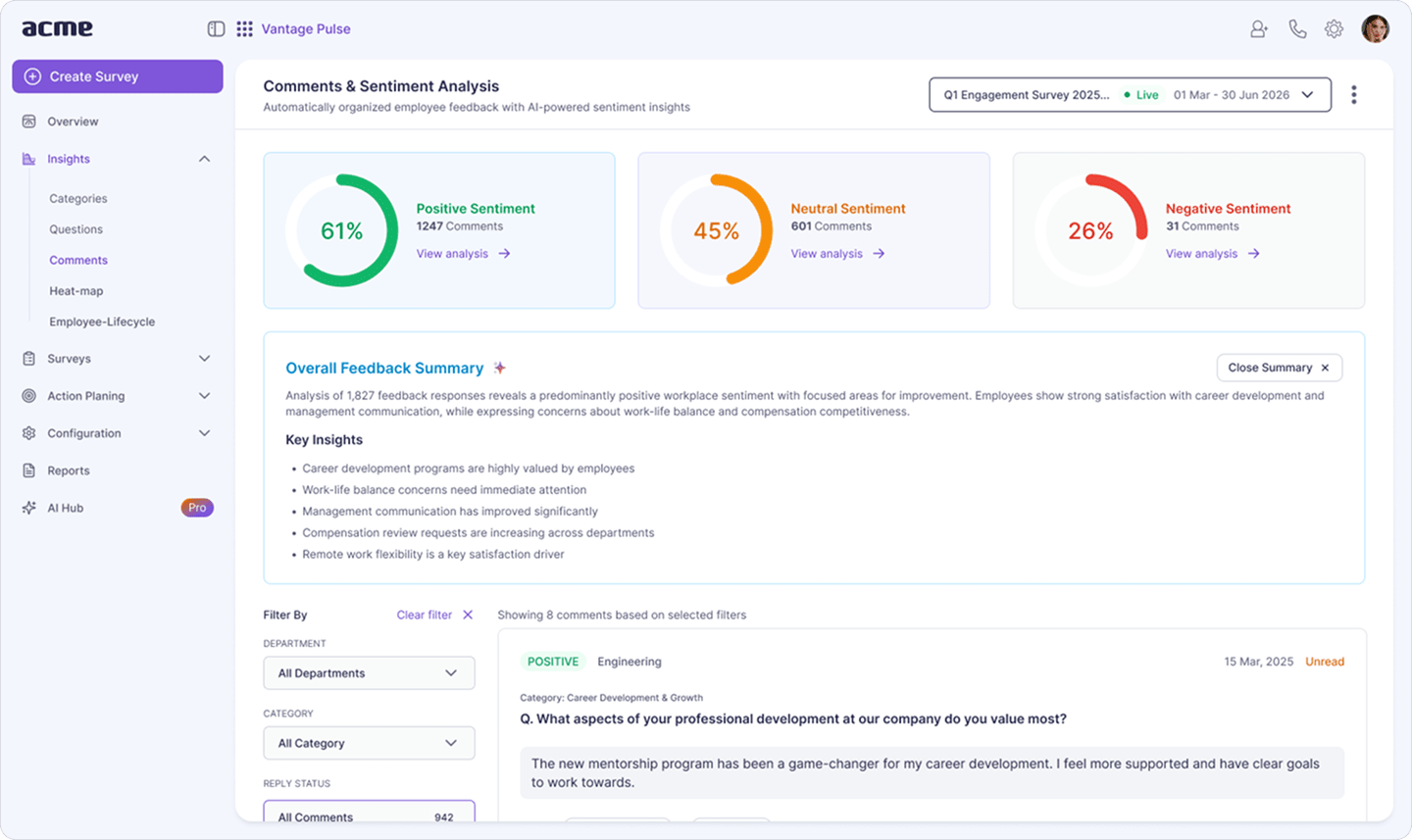
Vantage Pulse gives HR teams and team leads all three in a single dashboard. Sentiment analysis flags friction early. Department-wise Insights show where rules are landing and where they need revision.
Team Rules Examples by Team Type
Different team structures need different rule weightings. The core 10 rules apply universally. The language and priority shift based on how the team is structured and where it operates.
| Team Type | 3 Core Rules | Primary Measurement |
|---|---|---|
| Cross-functional project team | Named decision-maker per initiative, weekly written status update, 48-hour response SLA on blockers | On-time delivery rate, decision log coverage |
| Fully remote team | Async-first communication default, weekly synchronous video ritual, written decision log for all major calls | Meeting load per person per week, async response rate |
| High-performing sales team | Daily pipeline standup (15 minutes max), weekly peer recognition ritual, monthly manager-rep 1:1 | Quota attainment, team recognition coverage percentage |
| Engineering / product team | RFC-first (Request for Comments) for major decisions, explicit on-call boundaries, blameless postmortems within 48 hours of incidents | Incident Mean Time to Resolve (MTTR), pulse psychological-safety score |
For remote and distributed teams, Vantage Fit team wellness challenges add a shared-experience layer that rule 7 and rule 9 benefit from directly. Step competitions and activity streaks give geographically separated team members a reason to connect outside project work.
Related Read: How to Build a Strong Team Collaboration Framework
How to Set Teamwork Rules That Actually Stick
Writing a rules list takes one hour. Getting a team to follow it for a year takes a process. Here are five steps that produce lasting adoption.
Write the current unwritten rules first. Ask every team member to name two behaviors they observe as the real operating norms. Surface what is already implicit before writing anything new. The most important rule is usually already in the room, just unspoken.
Draft 7 to 10 candidate rules as a group, not from the top down. Rules imposed by leadership get surface compliance. Rules drafted together get real buy-in. Use a 60-minute workshop: each person proposes two rules, the group discusses, and the final list is voted on.
Define the measurable signal for each rule. For every rule adopted, name one metric that confirms it is being followed. "Recognize weekly" maps to recognition frequency. "Meetings have agendas" maps to a weekly spot-check ratio. If you cannot name a signal, the rule is too vague to enforce.
Pilot for 30 days, then review with pulse data. Run your first cycle, then send a short anonymous pulse survey with three questions: Is this rule clear? Is it being followed? Does it need adjustment? A themed recognition campaign tied to a rule's first 30 days, built through Vantage Rewards Campaign Management, drives adoption faster than documentation ever will.
Revise quarterly. Rules are living documents. Teams change. Work modes shift. A rule that worked for a co-located team needs rewriting when half the team goes remote. Build a 30-minute quarterly rules review into the team calendar and treat it as non-negotiable.
For guidance on creating shared professional standards, read our post on workplace etiquette rules.
The Bottom Line: Rules That Drive Measurable Team Performance
Most team failures are not talent failures. They are behavioral failures. The team knew what to do. It had no shared agreement on how to do it together.
The 10 rules above work because they are specific, observable, and each tied to a measurable signal. They are not a values statement. They are an operating agreement. And operating agreements can be tested, revised, and improved.
Start with the two or three rules that address your team's highest-friction areas. Run a 30-day pilot. Pull pulse data. Revise based on what the evidence shows, not the loudest voice in the room.
See how Vantage Pulse measures teamwork rule adherence across your organization. Book a Demo.
For more on building recognition cultures that make team rules stick, read our guide to peer recognition. For building the trust that underpins all 10 rules, see our guide to workplace relationships.
Frequently Asked Questions
What are good rules for teamwork?
Good rules for teamwork are specific, observable, and tied to a measurable signal. They describe a behavior, not a value. "Every meeting has a written agenda sent 24 hours in advance" is a good rule. "We respect each other's time" is a value. The strongest teamwork rules cover five areas: communication, conflict resolution, recognition, ownership clarity, and measurement. The 10 rules in this guide address all five and include a measurable signal for each one.
What are the 5 rules of a team?
The five most impactful rules for any team are: communicate openly on the record, agree on a conflict protocol before conflict happens, recognize contributions weekly, document every role and owner clearly, and measure whether the rules are actually working. These five address the most common team failure modes: information gaps, unresolved conflict, unacknowledged contributions, role ambiguity, and unchecked behavioral drift. They map directly to rules 1, 2, 4, 5, and 10 in the framework above.
What are the 5 P's of a team?
The 5 P's of a team are Purpose, People, Place, Process, and Performance. Purpose defines why the team exists. People defines who is on it and what roles they hold. Place defines where and how the team works, whether co-located, remote, or hybrid. Process defines how decisions, communication, and conflict get handled. Performance defines how outcomes are measured and recognized. Effective teamwork rules address all five P's to give teams a coherent operating model rather than a list of aspirations.
What are the 5 C's of teamwork?
The 5 C's of teamwork are Communication, Collaboration, Commitment, Creativity, and Celebration. Communication ensures information flows openly and on the record. Collaboration ensures work is distributed fairly and transparently. Commitment means team members follow through on agreed responsibilities. Creativity means diverse perspectives are structurally included in decision-making. Celebration means contributions are recognized in a timely and visible way. Use the 5 C's as a diagnostic: identify which one is weakest on your team and apply the corresponding rule from the framework above.
What are the 7 teamwork skills?
The 7 core teamwork skills are Communication, Active Listening, Reliability, Respect, Conflict Resolution, Empathy, and Adaptability. Communication ensures messages are clear and accessible to the whole team. Active Listening ensures every voice in a meeting is actually heard. Reliability means following through on commitments consistently. Respect means honoring focus time, off-hours, and differing perspectives. Conflict Resolution means addressing disagreement with a structured protocol rather than avoidance. Empathy means considering the impact of your decisions on others. Adaptability means updating both the work and the rules when the team's context changes.

This article is written by Nilotpal M Saharia. He is a Senior Content Marketing Specialist & R&R Strategist at Vantage Circle, with 8 years of expertise in Marketing, HR, and Content Strategy.
Connect with Nilotpal on LinkedIn.


