In many organizations, employee engagement is still spoken about in broad, aspirational terms. It’s something leaders want, but often struggle to operationalize.
Since organizations today are evolving faster than ever. Distributed teams, shifting expectations, and a renewed focus on employee well-being have pushed companies to rethink how they keep people connected to their work. Engagement is no longer just about annual surveys or occasional team activities. It requires continuous listening, thoughtful recognition, and measurable outcomes.
That’s where the employee engagement manager comes in.
But while the title is becoming more common across organizations, there is still a fair amount of confusion around what the role actually entails. What does an engagement manager do on a day-to-day basis? How do they influence culture at scale? And perhaps most importantly, how do they measure whether their efforts are truly improving engagement?
In this blog, we will explore the responsibilities of an employee engagement manager, the metrics they track, and why this role has become increasingly critical for organizations aiming to build a thriving workplace.
What Does an Employee Engagement Manager Do?
Think of the employee engagement manager as the architect of your workplace culture. While HR manages the operational side, the engagement manager focuses on something harder to measure but just as important. And that is how employees feel about coming to work each day.
At its core, the role is about creating a workplace where employees feel valued, motivated, and connected to the organization’s success.
Employee Engagement Manager vs HR Manager
| Dimension | Engagement Manager | HR Manager |
|---|---|---|
| Focus | Employee experience, culture, motivation, and belonging | Workforce operations such as hiring, compliance, compensation, policy |
| Approach | Strategic and experience-driven, focusing on employee sentiment and participation | Administrative and policy-driven, focusing on structure and HR processes |
| Primary Goal | Build a culture where employees feel valued, connected, and motivated | Ensure smooth HR processes and organizational compliance |
| Metrics of Success | Engagement scores, participation rates, employee feedback, retention trends | Hiring efficiency, compliance, payroll accuracy, policy implementation |
| Interaction with Employees | Focused on improving day-to-day employee experience and morale | Handles formal HR matters such as hiring, grievances, policies, and benefits |
Why This Role Matters More Than Ever?
According to Gallup, managers account for 70% of the variance in team engagement. In other words, the day-to-day experience of employees is shaped less by company slogans and more by how their managers lead, communicate, and recognize their efforts.
And yet, manager engagement itself is slipping. In 2024, manager engagement dropped from 30% to 27%, with managers under 35 falling five points and female managers falling seven. When the very people responsible for driving engagement begin to disengage themselves, the ripple effects are inevitable and measurable. Productivity slows, feedback loops weaken, and the sense of ownership that fuels high-performing teams starts to fade.
This is precisely why the employee engagement manager role has evolved into a business imperative. Engagement doesn’t sustain itself through occasional surveys or once-a-year celebrations. It requires consistent measurement, thoughtful interventions, and leadership visibility.
5 Core Engagement Manager Responsibilities That Drive Results
1. Design and Run Recognition Programs
Recognition is the most direct lever an engagement manager has. When employees feel genuinely seen for their contributions, discretionary effort follows. People do more of what gets noticed.
But recognition does not sustain itself through occasional praise or one-off appreciation moments. The real work for an engagement manager lies in designing recognition programs that operate consistently and fairly across the organization.
That means creating structured initiatives, from peer-to-peer recognition platforms to manager-led appreciation programs, that make recognition part of everyday work rather than an occasional event.
2. Build a Feedback Culture with Pulse Surveys
Feedback is how engagement managers stay ahead of problems instead of reacting to them. The traditional annual engagement survey is too slow to be useful. By the time the data is processed and acted on, the underlying issue has either calcified or triggered attrition.
Employee pulse surveys change that equation. By being short, frequent, and focused, they give engagement managers a continuous read on team sentiment rather than an annual snapshot.
The eNPS (Employee Net Promoter Score) is particularly valuable as a leading indicator. A declining eNPS in a specific business unit often predicts attrition months before it shows up in headcount reports.
Equally important is psychological safety in the feedback process. Anonymous responses consistently yield more honest signal than attributed ones. The goal isn't to collect data. It's to close the loop visibly.
3. Champion Learning and Development
Engagement and growth are inseparable in the minds of today's workforce, particularly among younger US professionals who rank career development as top drivers of job satisfaction.
The engagement manager's role here isn't to build L&D curriculum. It's to ensure learning is embedded in the engagement strategy through skill-building opportunities and career progression.
Recognizing someone for completing a certification matters as much as offering the certification itself. It signals that growth is valued here, not just expected. This responsibility also gives engagement managers a powerful retention argument in the boardroom.
4. Drive DEI Initiatives
Over the past decade, diversity has evolved from a corporate talking point to a strategic priority. But building a diverse workforce is only the first step. The real challenge lies in creating a workplace where people from different backgrounds feel genuinely included, respected, and heard.
While leadership may define the vision for DEI, engagement managers help bring that vision to life in everyday employee experiences. Through engagement programs, recognition initiatives, and open feedback channels, they help ensure that inclusion becomes part of the organization’s culture rather than just a policy statement.
When done well, these efforts encourage diverse perspectives, help address unconscious bias, and create space for underrepresented voices to contribute and thrive. The result is not only a stronger sense of belonging but also improved collaboration, creativity, and innovation.
Recommended Read: Diversity and Inclusion in the Workplace: A Complete Guide
5. Own Engagement Metrics and Report to Leadership
This is where influence becomes authority. An engagement manager who can walk into a leadership meeting with a clear, data-backed narrative about program health has the power to drive strategic decisions.
The most effective engagement managers don’t rely on intuition alone. They operate with a clear North Star metrics framework that helps them measure whether engagement initiatives are actually shaping behavior across the organization.
A few indicators that tends to matter are:
- Receiver Coverage: What percentage of employees received at least one recognition in the past 30/90 days? Low coverage signals that recognition is clustered rather than cultural.
- Giver Coverage: What percentage of employees gave recognition? This measures whether appreciation has become a genuine behavioral norm, not just a top-down exercise.
- Recognition Frequency: How often is recognition happening across the organization? Frequency is the best proxy for whether recognition is habitual or episodic.
- Program Usage: Are employees actively redeeming, participating, and returning to the platform? Adoption data reveals whether the program is embedded in daily work or treated as an afterthought.
These four metrics together give leadership a real-time pulse on whether the engagement investment is working.
Tools Engagement Managers Use
Many engagement initiatives begin with enthusiasm yet lose momentum over time. It happens not because the ideas were flawed, but because the infrastructure to sustain them was missing.
For employee engagement managers, the right technology stack turns good intentions into consistent, measurable practices. These tools make it easier to listen to employees, recognize contributions, track sentiment, and keep teams connected across locations.
Recognition & Rewards Platform
A well-designed R&R Platform enables peer-to-peer recognition, manager-led appreciation, milestone awards, and points-based rewards that are aligned with the organization’s core values.
For engagement managers, the right infrastructure makes a meaningful difference. Features such as a global rewards catalog, mobile accessibility, and an analytics dashboard help ensure that recognition is both accessible and measurable across the organization.

Source: Vantage Perks
When these elements are in place, recognition becomes consistent and scalable rather than occasional or informal. Platforms like Vantage Recognition are designed with this goal in mind. It helps engagement leaders run recognition programs across teams and geographies while maintaining the personal, human aspect of appreciation.
Pulse Survey & eNPS Tool
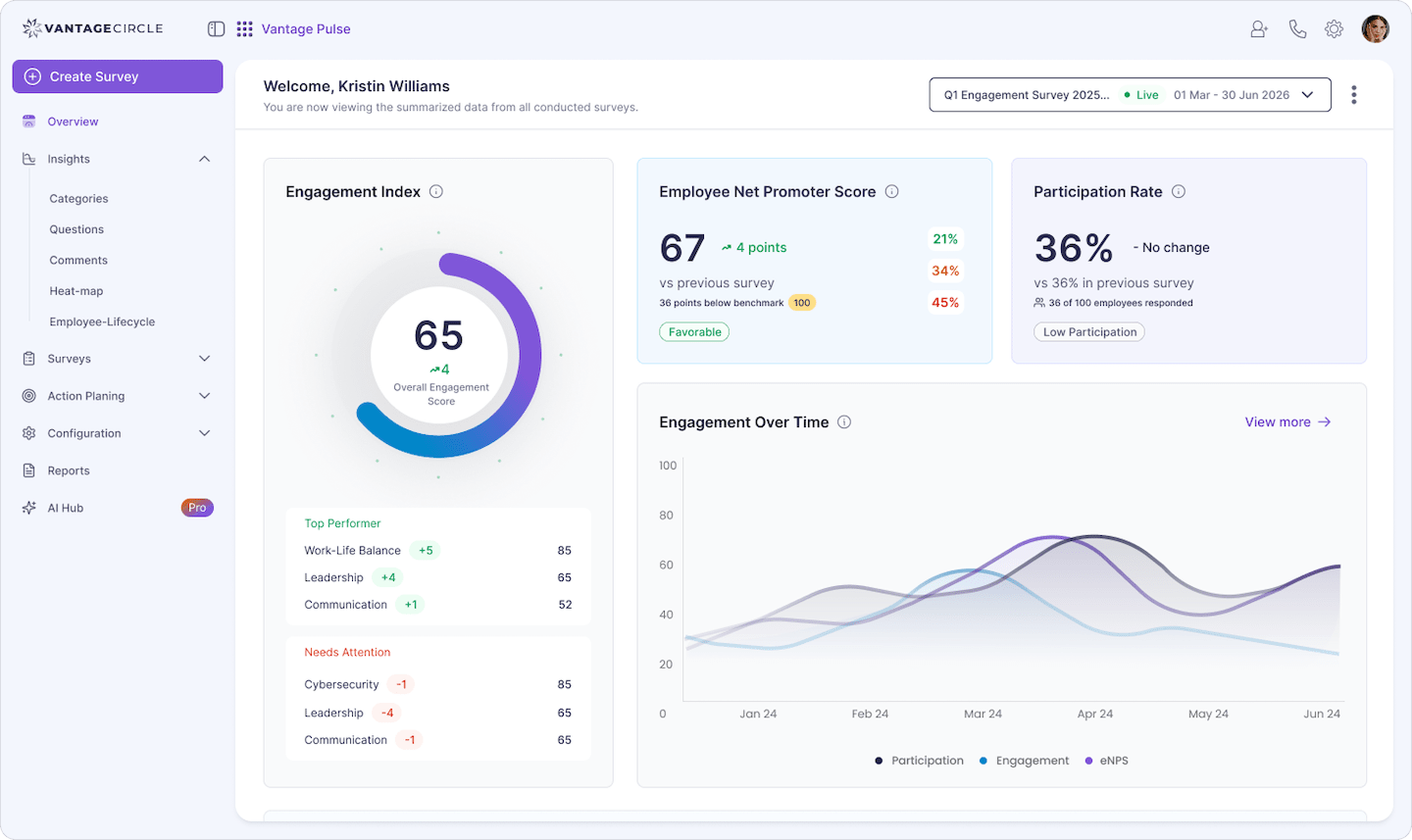
An effective engagement strategy also relies on tools that help organizations stay close to employee sentiment. Pulse surveys and eNPS tools act as an early listening system, replacing the slow, once-a-year engagement survey with shorter, more frequent check-ins that capture how employees are feeling in real time.
The most effective solutions are designed to fit naturally into employees’ daily workflows. Integrations with platforms like Slack or Microsoft Teams help reduce participation friction and significantly improve response rates.
Equally important is trust. Anonymous feedback options allow employees to share their views candidly. It ensures that the insights collected reflect genuine experiences rather than cautious responses.
Source: Vantage Pulse
Learning & Development Platform
A strong learning and development platform can help organizations support continuous skill-building while giving engagement managers visibility into how employees are progressing in their careers.
The right platform does more than host courses. Features such as personalized learning paths and manager dashboards make it easier to track development across teams and identify opportunities for growth. These insights also allow organizations to connect learning milestones to recognition and appreciation.
Internal Communications Tool
Workplace culture rarely develops through occasional town halls or quarterly updates. It grows through consistent communication that keeps employees informed, connected, and aligned.
A strong internal communications platform helps maintain this connection across teams and locations. Tools like Slack or Microsoft Teams have become central to how many companies share updates, celebrate wins, and keep conversations flowing throughout the workday.
But effective communication goes beyond simply broadcasting messages. The most useful platforms also provide engagement insights that help leaders understand whether their messages are actually resonating with employees.
Conclusion
As workplaces continue to evolve, maintaining employee engagement becomes increasingly complex. Changing expectations, distributed teams, and rapid organizational growth all make it harder to keep employees consistently connected to their work and the organization.
This is where employee engagement managers play a vital role. By combining the right strategy with the right tools, they help ensure that engagement is not left to chance but becomes a sustained and measurable part of the organization’s culture.
FAQ
Q1: What does an Employee Engagement Manager do?
An employee engagement manager designs and manages programs that improve employee motivation, recognition, communication, and workplace culture.
Q3: What Skills does an Employee Engagement Manager need?
The key skills that an employee engagement manager needs are great communication, data analysis capabilities, program management, emotional intelligence, and the ability to design culture and recognition initiatives.
Q4: How is an Engagement Manager different from an HR manager?
An engagement manager focuses on improving employee experience and culture, while an HR manager oversees HR operations such as hiring, compliance, payroll, and policies.
Q5: What metrics should an Engagement Manager track?
Common metrics include engagement scores, eNPS, recognition participation, employee feedback trends, and retention or turnover rates.

This article is written by Shikha Gogoi. Shikha is a Content Marketing Specialist focused on SEO-driven content around employee engagement, recognition, and workplace culture, helping build people-first workplaces.
Connect with Shikha on LinkedIn.