Disengagement costs the global economy $8.8 trillion every year. That figure comes from Gallup's most recent research. It is a number large enough to fund most countries' national budgets.
Yet most organizations still respond to this problem the same way. They run an annual engagement survey. They add a new perk. They wonder why retention stays flat.
The real issue runs deeper. Employees are not disengaged because they lack perks. They are disengaged because their day-to-day experience at work does not give them a reason to stay invested.
Employee experience (EX) is the sum of every interaction an employee has with your organization, from the first job posting they see to their exit interview. It covers physical workspace, technology and tools, company culture, manager relationships, growth opportunities, recognition, and wellbeing support. For HR leaders, EX is the input you control. Employee engagement is the output you measure.
Get employee experience right, and engagement follows. So does retention, productivity, and customer satisfaction.
This guide walks you through everything organizational leaders need to know. What employee experience actually means. Why it drives business outcomes. The frameworks, strategies, and real-world examples that separate high-performing employee experience programs from the ones that exist only on paper.
What is Employee Experience?
"The employee experience is the cumulative assessment of an employee's interaction with your company and its people."
— Julian Lute, Senior Strategic Advisor at Great Place To Work
When we talk about employee experience, we are not talking about ping-pong tables or free lunches. We are talking about the full picture of what it feels like to work at your company. Every interaction. Every moment. Every decision that affects your people.
Think about what that actually includes:
- How your culture makes people feel on a regular Tuesday, not just during a company offsite
- The quality of relationships employees build with their managers and peers
- Whether people have the tools and technology to do their jobs without unnecessary friction
- The opportunities available to them to learn, grow, and move forward in their careers
- How recognized and valued they feel for the work they put in
At its core, employee experience is about emotional connection. You want your people to feel trusted, respected, and genuinely glad to be part of the organization.
When that connection exists, employees do not just show up. They show up invested. They solve harder problems, bring more creativity to their work, and treat customers better. That investment shows up directly in business performance.
When that connection is missing, the opposite is true. Work becomes transactional. People do the minimum. And eventually, they leave.
The organizations that understand this distinction are the ones building EX as a deliberate program, not as an afterthought.
The Three Pillars of Employee Experience
Employee experience does not live in one place. It is shaped by three interconnected environments that employees move through every single day. Get all three right, and you create conditions where people can do their best work. Let even one of them slip, and the cracks show up quickly.
Physical Environment
This is the most visible pillar. It covers everything employees can see and touch. Office layout, desk setup, lighting, meeting rooms, equipment, and the general workspace design all fall here.
For organizations with remote or hybrid teams, the physical environment extends beyond the office. It includes the home setup you help employees create and the co-working spaces you provide access to.
The question to ask here is straightforward. Does the physical environment make work easier, or does it get in the way?
Digital Environment
This pillar has grown significantly in importance over the last few years. Employees now interact with technology constantly, across every stage of their journey. The tools they use to communicate, collaborate, submit requests, access information, and get recognized all shape how they experience work.
A fragmented tech stack is one of the most common and most avoidable sources of friction in employee experience. When employees have to toggle between a dozen disconnected platforms just to complete routine tasks, frustration builds fast.
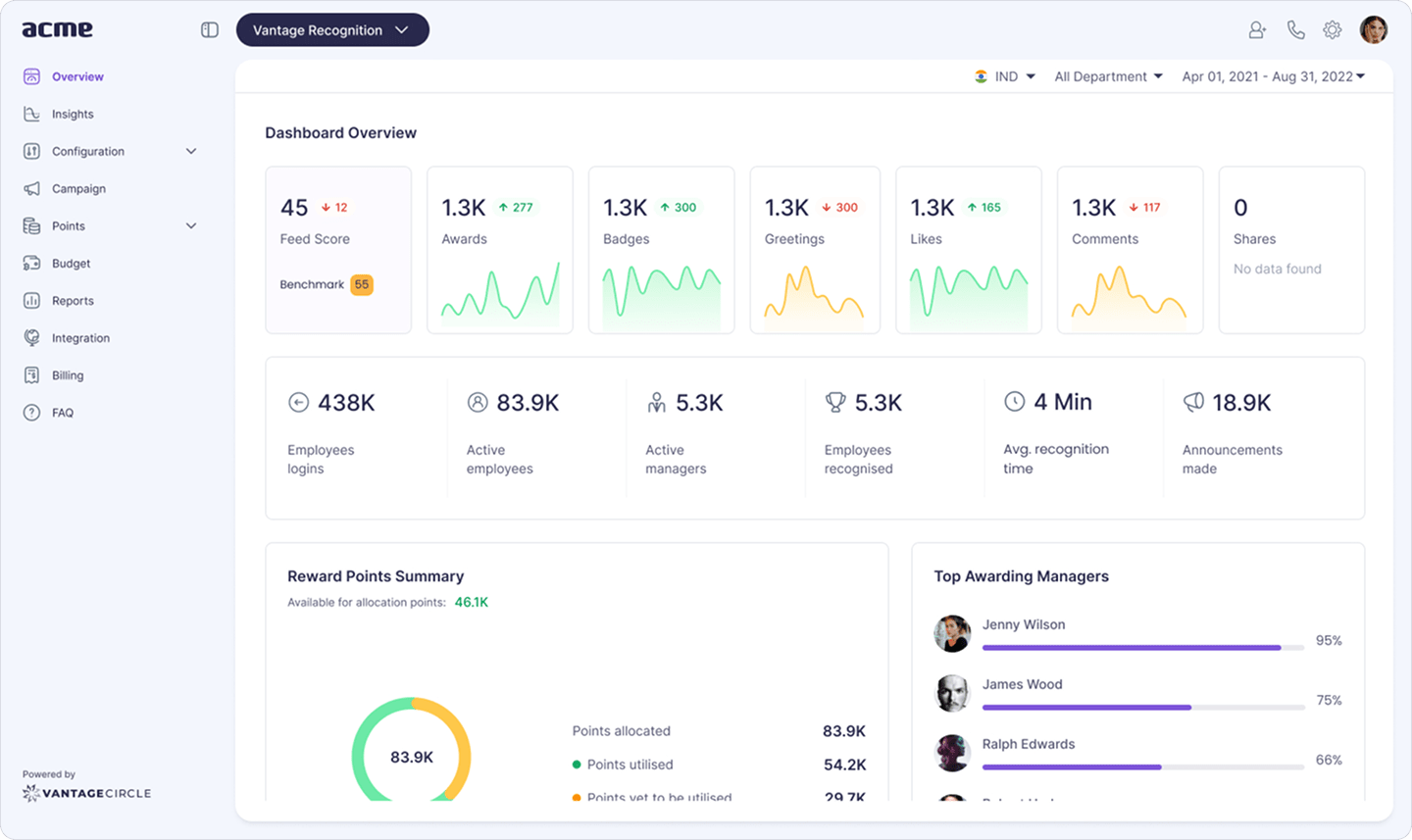
This is also where employee experience platforms come in. A unified platform that brings together recognition, surveys, wellness, and perks removes that friction and gives HR leaders a single view of what is happening across the organization.
Cultural Environment
This is the hardest pillar to measure, and often the most powerful one.
Culture is what employees experience when no one is watching. It is the unwritten rules about how decisions get made, how people treat each other, and whether leadership actually lives the values written on the wall.
It shows up in whether a manager takes credit for a team's work or gives credit to the team. It shows up in whether a junior employee feels safe raising a concern. It shows up in whether recognition is genuine and frequent, or hollow and rare.
According to the AIRe Report, recognition-driven cultures show 92% retention compared to 76% in low-recognition cultures. That 16-point gap is culture doing its job, or failing to.
All three pillars work together. A beautiful office with a broken tech stack and a toxic culture will not retain good people. A strong culture with outdated tools and no workspace investment will eventually wear people down. The organizations that lead on EX treat all three as equal priorities.
Why Employee Experience Matters for HR Leaders
Most leaders agree that employee experience is important. Far fewer treat it as a business priority with measurable outcomes attached to it.
That gap is expensive.
Gallup's State of the Global Workplace Report confirms that 77% of employees are not engaged or actively disengaged. That means roughly three out of every four people in a typical organization are not bringing their full effort to work. They are present, but not invested.
The business consequences of that are real. Teams with low engagement produce less, innovate less, and turn over more. The cost of replacing a single employee can run anywhere from half to two times their annual salary, depending on the role. Multiply that across an organization and the numbers get significant fast.
Now flip it. Organizations that invest in employee experience see measurably different outcomes. Engaged teams are 21% more productive. They deliver better customer service. They stay longer. They refer other strong candidates. They become the kind of workforce that compounds over time rather than constantly needing to be rebuilt.
There is also a talent acquisition angle that leaders often underestimate. Job seekers consider employee experience a crucial factor in their decision-making process. Your EX is not just an internal matter. It is part of your employer brand, and it is visible to candidates before they ever apply.
One more thing worth calling out here. There is a difference between employee satisfaction and employee experience, and conflating the two is a common mistake. Satisfaction measures how content someone is at a given moment. Experience is the full arc of their journey with your organization. The data makes the distinction important: 20–40% of all employees (satisfied or not) consider leaving, often for better pay/career growth as per SHRM. Satisfaction does not equal retention. Experience does.
That is why HR leaders, CHROs, and executive teams need to move beyond satisfaction scores and start treating EX as the strategic program it is.
Why Do HR Leaders Need to Focus on Employee Experience?
The case for EX is not new. But the urgency around it has changed considerably.
Several forces are reshaping the world of work simultaneously. HR leaders who understand these forces are better positioned to respond to them. Those who do not are often left reacting to problems that were entirely predictable.
Here are the three shifts driving that urgency.
Changing Workforce Demographics and Expectations
The workforce is getting younger, and younger employees have different expectations from work.
Millennials and Gen Z now make up the majority of the global workforce. These are not employees who will stay in a job simply because it pays well. They want work that aligns with their values. They want to know their contributions matter. They want feedback that is frequent and specific, not delivered once a year in a formal review.
The numbers reflect this clearly. According to the AIRe Report, 79% of Gen Z employees seek frequent, real-time recognition. That is not a preference. For this generation, it is close to a baseline expectation.
HR leaders who design experience programs around the assumptions of a workforce from ten years ago will struggle to engage the workforce they actually have today.
The Rise of Social Media and Employer Transparency
Workplace culture is no longer a private matter.
Employees share their experiences publicly, on platforms like Glassdoor, LinkedIn, and increasingly on short-form video. A single candid post about a toxic manager or a broken onboarding process can reach thousands of potential candidates within hours.
This cuts both ways. Organizations with genuinely strong employee experiences attract talent organically. Employees become advocates. They refer friends, share positive stories, and build the kind of employer reputation that no job advertisement can replicate.
The reverse is equally true. A poor experience does not stay inside the organization anymore. It travels.
A More Volatile and Uncertain Business Environment
The pandemic reshaped expectations around flexibility, wellbeing, and the relationship between employer and employee in ways that have not fully reversed.
Economic uncertainty, rapid digitalization, and the rise of AI are adding further pressure. Roles are changing faster than they used to. Employees are being asked to adapt constantly. In that environment, the organizations that hold onto their best people are the ones that have built genuine trust and a strong sense of belonging.
Your workforce is your most valuable asset in volatile times. EX is how you protect it.
The Employee Experience Lifecycle
Employee experience is not a single moment. It is a journey that unfolds across six distinct stages, from the first time a candidate encounters your organization to the day they leave it.
Each stage presents its own opportunities and its own risks. A strong onboarding experience can set an employee up for years of high performance. A poor exit experience can undo years of goodwill and send someone out the door who becomes a vocal critic of your brand.
Understanding each stage clearly is the starting point for designing an experience that holds up across the full journey.
| Stage | What Happens | Key EX Metric | VC Product |
|---|---|---|---|
| Attract | Employer brand building, job postings, candidate outreach | Applicant-to-interview rate | — |
| Hire | Interviews, assessments, offer management | Offer acceptance rate | — |
| Onboard | Role setup, tool access, cultural integration, early manager relationship | 90-day retention rate | Vantage Recognition (welcome campaigns) |
| Engage | Day-to-day motivation, recognition, team culture, manager quality | eNPS, recognition frequency | Vantage Recognition, Vantage Pulse |
| Develop | Skills growth, career pathing, internal mobility, learning opportunities | Internal mobility rate | — |
| Exit | Offboarding, knowledge transfer, alumni relationships | Regrettable attrition rate | Vantage Pulse (exit surveys) |
The AIRe Employee Experience Framework
Most EX frameworks tell you what to focus on. Very few tell you how to actually build a program that sustains itself over time.
That is the gap the AIRe Framework was designed to fill. AIRe is a behavioral science-based approach to designing employee experience programs that drive measurable outcomes. It is built on four components, each addressing a distinct layer of how employees connect with their organization.
Appreciation
Appreciation is the foundation. It is about making employees feel genuinely valued for the work they do, not just when they hit a major milestone, but consistently, in the everyday moments that most organizations overlook.
A timely, specific acknowledgment from a manager or a peer can have a stronger impact on employee sentiment than an annual award. The keyword is timely. Recognition that comes weeks after the fact loses most of its meaning.
Incentivization
Appreciation addresses the emotional layer. Incentivization addresses the behavioral one.
This component is about designing recognition that reinforces the behaviors your organization actually wants to see more of. That could be collaboration, innovation, customer service excellence, or values-driven decision making.
Done well, incentivization turns recognition into a tool for culture building, not just a feel-good exercise.
Reinforcement
A recognition program that launches with energy and fades within six months is one of the most common failures in EX.
Reinforcement is about building recurring touchpoints into the employee journey. Themed recognition campaigns, milestone celebrations, peer nomination cycles, and manager-led check-ins all serve as reinforcement mechanisms. They keep participation alive and signal to employees that the program is not a one-time initiative. It is how things work here.
eMotional Connect
This is the most nuanced component, and often the most powerful.
eMotional Connect is about personalization. It recognizes that employees are not a homogeneous group. A 28-year-old individual contributor and a 45-year-old senior manager have different motivations, different communication preferences, and different definitions of what a meaningful experience looks like.
Programs that treat everyone the same tend to resonate with no one in particular. Programs that account for individual differences — through personalized rewards, tailored communication, and role-specific recognition — build the kind of belonging that drives long-term retention.
According to the AIRe Report, recognition-driven cultures achieve 92% retention compared to 76% in organizations with low recognition. The eMotional Connect component is a significant driver of that gap.
Together, these four components give HR leaders a structured way to design, measure, and continuously improve their EX programs. Rather than running disconnected initiatives, AIRe provides a single coherent framework that connects every recognition and engagement effort to a clear behavioral outcome.
You can explore the full AIRe framework and the research behind it in the AIRe Report.
Challenges of Employee Experience
Crafting superior employee experience nowadays is tougher than ever. Between pandemic shakeups, talent wars, and economic rollercoasters, employees expect a lot. Leaders must step up on a bunch of fronts.
1. Instilling Confidence in Uncertain Times
The number one challenge of employee experience is being real about where the company stands amidst uncertainty. Employees seek business health to understand how it might impact their own situation.
This is a very critical scenario for business leaders. They must walk tightropes, acknowledging workforce concerns without fueling deeper uncertainty.
Also, leaders have to maintain engagement during the uncertainty. They can achieve this by:
- Openly communicating about company standings
- Providing open forums where people can get their outstanding questions answered
2. Respecting Work-Life Balance
The boundaries between work and personal life have shifted permanently for most employees. Hybrid and remote arrangements have given people more flexibility, but they have also made it harder to fully switch off.
Burnout is the consequence when those boundaries are not protected. And burnout is not a soft problem. It shows up in absenteeism, declining performance, and eventually, resignation.
The responsibility here sits with leadership as much as it does with individual employees. Managers set the tone. If a manager sends emails at 11pm and expects responses, that behavior defines the team's culture regardless of what the official policy says.
Organizations that take work-life balance seriously give employees genuine flexibility, not just the appearance of it. They train managers to model healthy boundaries. And they build workload visibility into their operating rhythm so that chronic overload is caught before it becomes a crisis.
3. Streamlining Outdated Processes
Nobody wants to wrestle with outdated, bureaucratic processes that overwhelm more than enable.
It's the leaders' responsibility to upgrade the old ways of working and map clearer workflows. They can achieve this by:
- Leveraging technology and software to automate manual tasks
- Regularly soliciting user feedback on pain points to increase employee efficiency
These investments show that empowering employees matters to the organization. Additionally, it results in better experience and performance.
4. Connecting Culture and Values
Simply paying your employees for their work is no longer enough. Employees today want to establish a connection between their work and the purpose behind it. The purpose gives them the motivation to thrive in the workplace.
Therefore, organizations must understand and engage with those intrinsic motivations by embedding declared values into actual EX. This requires authenticity from the leaders, such as:
- Demonstrating personal commitment to inclusion
- Upholding ethically, socially, and environmentally conscious practices
- Leading by example rather than just touting them in an attempt to earn employee trust
How to Improve Employee Experience: 7 Strategies for HR Leaders
Knowing what shapes employee experience is one thing. Knowing where to act is another. These seven strategies give HR leaders a practical starting point.
1. Foster Inclusive Leadership
Employees perform better when they feel their manager genuinely values their perspective.
Inclusive leadership correlates with higher team performance, with HBR research showing inclusive organizations achieve 19% more innovation revenue and 70% greater market expansion success.
Inclusive leadership is not a personality trait. It is a set of behaviors that can be trained, measured, and reinforced. Organizations that invest in this see the returns in engagement, psychological safety, and team output.
2. Prioritize Employee Wellbeing
Burnout is not a personal failing. It is an organizational problem. According to Gallup, 76% of employees report experiencing burnout at their current job at least sometimes.
Wellbeing programs that actually work go beyond gym memberships. They address mental health support, workload visibility, flexible scheduling, and manager behavior. When employees feel cared for as whole people, their performance and loyalty reflect that.
3. Support Hybrid and Remote Workers
Hybrid work is no longer an experiment. It is the default for a large share of the global workforce.
The risk for remote employees is what researchers call the "belonging tax." They do the same work but miss the informal moments that build relationships and visibility. Organizations need to close that gap deliberately through consistent communication, virtual connection opportunities, and promotion practices that do not favor proximity.
4. Use Pulse Surveys
Annual engagement surveys tell you how employees felt several months ago. Pulse surveys tell you how they feel now.
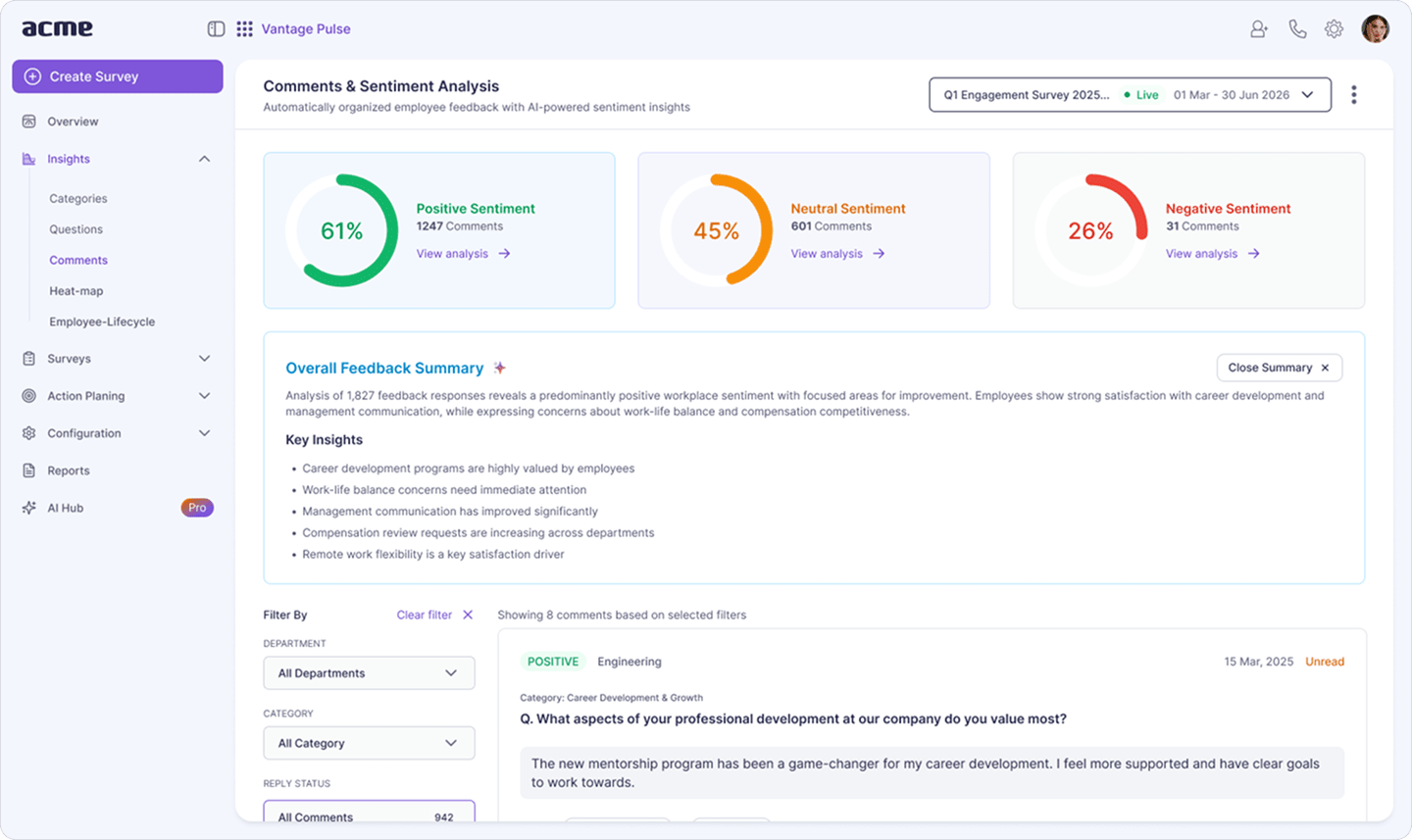
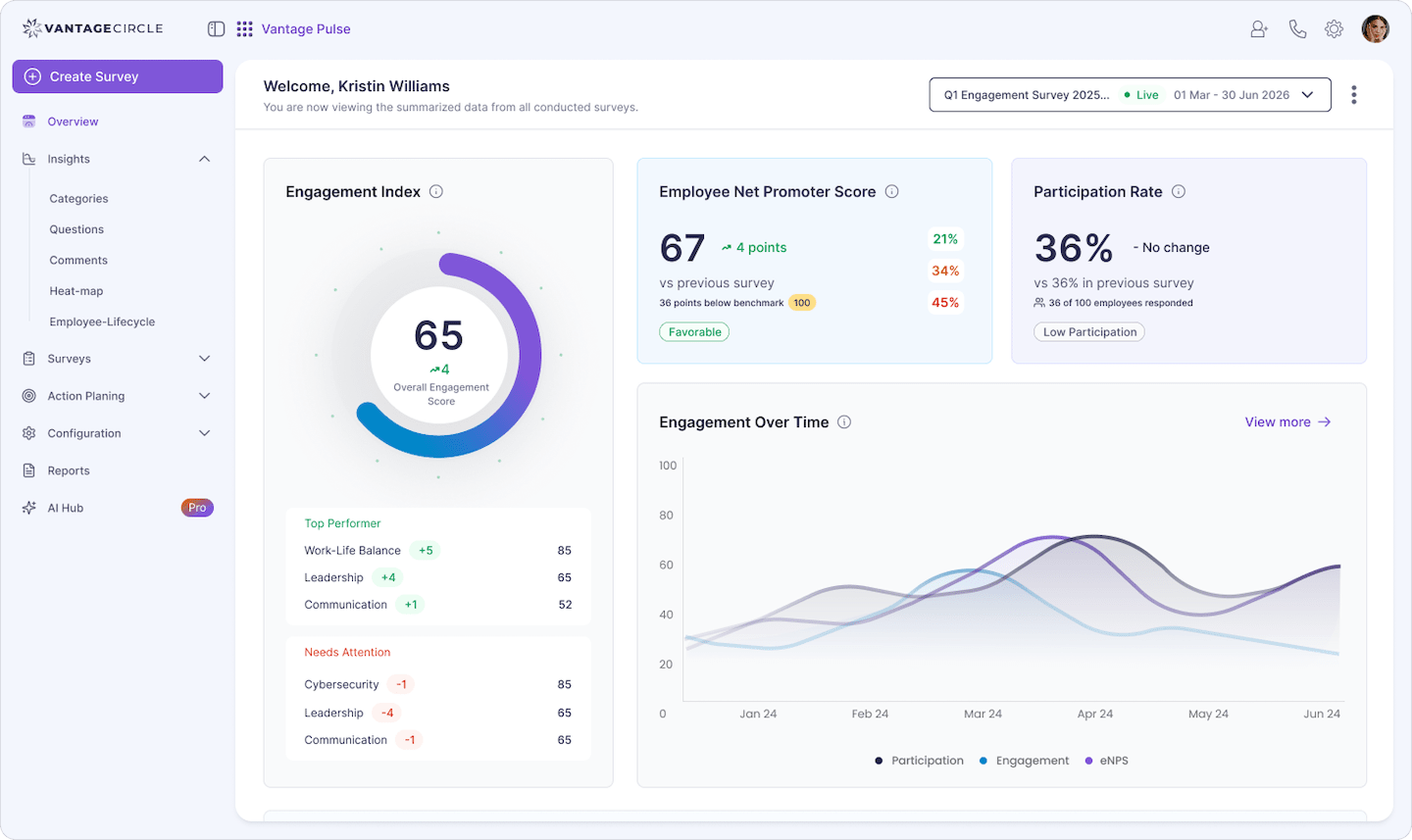
Brief, frequent surveys give HR leaders real-time signal on what is working and what is not. Vantage Pulse takes this further with AI-powered sentiment analysis on open-text responses, surfacing themes that would otherwise stay buried in spreadsheet exports. The data is only useful, however, if it leads to visible action. Employees stop responding when they see nothing change.
5. Improve Onboarding
The first 90 days shape an employee's long-term relationship with your organization more than almost any other period. Yet onboarding is consistently one of the most underfunded stages in the employee lifecycle.
Effective onboarding gives new hires clarity on their role, connection to the culture, and a relationship with their manager that starts on the right footing. Structured check-ins at 30, 60, and 90 days help catch problems before they become disengagement.
6. Invest in Upskilling and Reskilling
Employees who see a path forward stay. Those who feel stuck leave.
Learning and development is not just a retention tool. It is how organizations build the internal capability they need to stay competitive. Making internal mobility paths visible and accessible is as important as the programs themselves.
7. Recognize and Celebrate Consistently
Recognition is one of the highest-return investments in employee experience, and one of the most consistently underdone.
The data from Vantage Circle's own enterprise programs clearly makes the case. Wipro's recognition program delivers one recognition moment every 1.2 minutes across 230,000 employees. LTTS achieved 93% employee participation in their recognition program. Tata Communications saw 185% growth in peer-to-peer recognition after embedding recognition into their daily workflow.
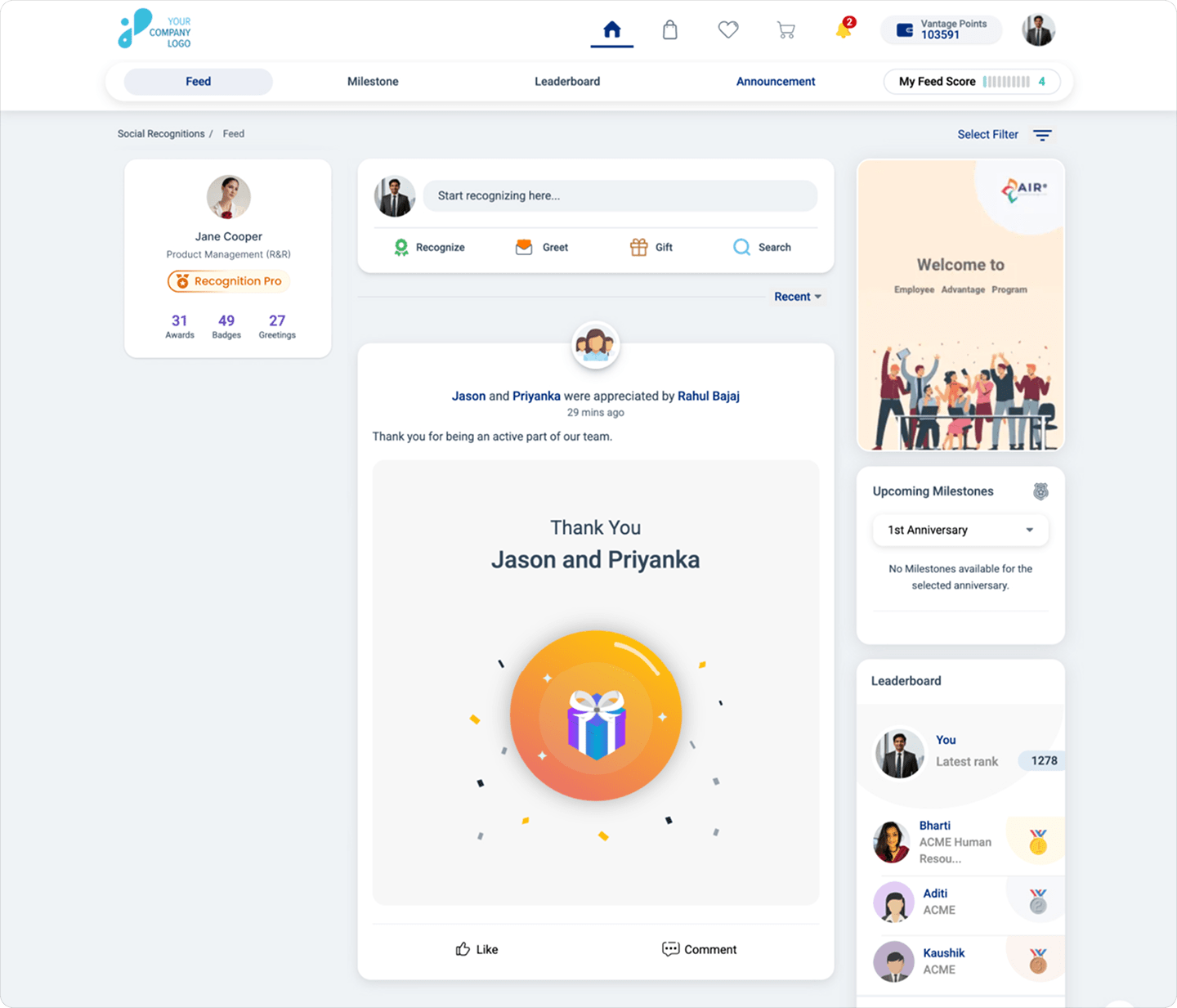
Platforms like Vantage Circle's recognition engine help HR leaders track recognition frequency, giver coverage, and receiver coverage at scale, turning recognition from a random act into a measurable culture signal.
AI and Technology in Employee Experience
Technology has always shaped how work feels. What has changed is the pace and the depth of that influence.
AI is now embedded in how organizations hire, onboard, develop, and retain employees. Sentiment analysis tools surface burnout signals before they become resignations. Predictive analytics flag attrition risk in specific teams. Personalized learning platforms recommend development opportunities based on individual career paths rather than generic job levels.
This matters for EX because personalization at scale was previously impossible. HR teams could not meaningfully tailor the experience for thousands of employees simultaneously. AI makes that feasible.
The second shift is in the HR tech itself. Fragmented tools create fragmented experiences. When recognition, surveys, wellness, and perks live on disconnected platforms, employees feel that disconnection. Unified employee experience platforms remove that friction and give HR leaders a single view of EX health across the organization.
The third consideration is balance. AI can personalize and streamline, but it cannot replace the human relationships that sit at the core of employee experience. The manager who gives specific, timely feedback. The peer who notices when someone is struggling. The leader who communicates honestly during a difficult quarter. Technology supports those moments. It does not substitute for them.
Organizations that use AI to enhance human connection rather than replace it are the ones seeing the strongest EX outcomes.
Employee Experience Examples: What Good Experience Looks Like
Frameworks and strategies are useful. But seeing what strong EX actually produces in practice is more convincing than any model.
Three organizations that have built their EX programs through Vantage Circle illustrate what is possible at enterprise scale.
Wipro operates across 230,000 employees globally. Scaling recognition so that every individual feels seen at that size is a genuine operational challenge. Their program now delivers one recognition moment every 1.2 minutes, making recognition a constant thread in the employee experience rather than an occasional event.
LTTS focused on participation as their primary metric, knowing that a recognition program only works if employees actually use it. They achieved 93% employee participation, a figure that reflects how deeply the program was embedded into daily workflows rather than sitting as an optional extra.
Tata Communications used peer-to-peer recognition as a culture signal. A 185% growth in peer recognition activity indicates something meaningful: employees are not just receiving recognition from managers, they are actively giving it to each other. That shift is what a recognition culture actually looks like in practice.
How to Design an Employee Experience Strategy
A strong EX program does not happen by accident. It is designed deliberately, measured consistently, and improved over time.
Here is a seven-step framework for building one that holds up.
Define your objectives. Be specific about what success looks like. Higher retention, stronger engagement scores, faster onboarding ramp time. Vague goals produce vague results.
Research what employees actually experience. Use engagement surveys, focus groups, and one-on-one interviews. Do not assume you already know where the friction is.
Map the employee journey. Identify every significant touchpoint across the lifecycle. Note where the experience is strong and where it breaks down.
Build a positive work environment. Foster open communication, embed recognition into daily workflows, and ensure wellbeing is treated as an operational priority, not a benefits line item.
Personalize where possible. Different employee segments have different needs. Gen Z employees may want mentorship and real-time feedback. Senior managers may need leadership development and autonomy. Design for the range, not the average.
Measure with clear KPIs. Track retention rates, eNPS, recognition frequency, internal mobility, and engagement survey results. Connect these metrics to business outcomes so EX investment has a defensible ROI.
Iterate continuously. Employee needs change. Business conditions change. Your EX strategy should be reviewed regularly and updated based on what the data and your employees are telling you.
For a deeper look at measuring EX outcomes, see our guide on employee experience management.
Employee Experience vs. Employee Engagement vs. Employee Satisfaction
These three terms are often used interchangeably. They should not be.
| Employee Experience | Employee Engagement | Employee Satisfaction | |
|---|---|---|---|
| What it is | The full journey an employee has with your organization | The emotional commitment an employee has to their work and organization | How content an employee feels at a given point in time |
| Direction | Bottom-up. Shaped by everything the employee encounters | Top-down. Driven by how well the organization supports performance and purpose | A snapshot. How someone feels today |
| Focus | The individual and their entire lifecycle | The workplace and productivity outcomes | Momentary sentiment |
| Key insight | EX is the input HR controls | Engagement is the output EX produces | Satisfaction does not predict retention |
That last row is the most important one. According to approved VC data, 88% of satisfied employees still plan to leave their jobs. Satisfaction tells you someone is not unhappy. It does not tell you they are committed. Only a strong employee experience builds that commitment over time.
Leveraging Employee Experience to Boost Customer Experience
There is a direct line between how your employees feel and how your customers are treated.
Employees who are engaged bring energy and care to customer interactions. They listen better, resolve issues faster, and represent your brand in the way you would want. Employees who are disengaged do the opposite, not out of malice, but because disengagement is contagious and it shows.
As Sir Richard Branson put it: "Clients do not come first. Employees come first. If you take care of your employees, they will take care of the clients."
The data supports this. Organizations that prioritize EX consistently report stronger customer satisfaction scores, higher Net Promoter Scores, and better brand reputation over time.
Investing in EX is not separate from investing in customer experience. For most organizations, it is the same investment.
Types of Employee Experience Surveys
Surveys are one of the primary tools HR leaders use to understand and improve EX. But not all surveys serve the same purpose. Using the right one at the right stage of the employee lifecycle makes the difference between actionable data and noise.
Candidate Attraction Surveys capture how applicants experience your hiring process. They surface friction points in recruitment before they start costing you strong candidates.
New Hire Onboarding Surveys run at the 30, 60, and 90-day marks. They reveal whether new employees feel supported, clear on their role, and connected to the culture during the period when they are most likely to leave.
Annual Engagement Surveys provide a comprehensive baseline. They measure sentiment across culture, leadership, development, and manager quality. Anonymity is essential here for honest responses.
Pulse Surveys are short, frequent, and built for speed. They give HR leaders a real-time read on specific issues without waiting for the annual cycle. Particularly useful during periods of change or uncertainty.
Exit Surveys are one of the most underused sources of insight available to HR teams. Departing employees have little reason to soften their feedback. Their responses often reveal systemic issues that current employees are reluctant to raise.
360-Degree Feedback Surveys provide multi-directional perspective on leadership effectiveness and team dynamics. They are particularly valuable for identifying development needs in managers, whose behavior shapes EX more than almost any other single factor.
Final Words
Employee experience is not a one-time initiative. It is an ongoing commitment to creating conditions where people can do their best work and want to stay.
The organizations winning on EX in 2026 are not necessarily the ones with the biggest budgets. They are the ones that listen consistently, act on what they hear, and treat their people as the primary driver of business performance rather than a line item to be managed.
The frameworks, strategies, and data in this guide give you a starting point. But the real work is in execution and in building an employee experience program that is measurable, sustainable, and human at its core.
Frequently Asked Questions About Employee Experience
What is meant by employee experience?
Employee experience is the sum of every interaction an employee has with your organization throughout their entire journey, from recruitment to exit. It covers culture, technology, physical environment, manager relationships, growth opportunities, and recognition.
What are the three pillars of employee experience?
The three pillars are the physical environment, the digital environment, and the cultural environment. All three shape how employees feel about their work on a daily basis.
What makes a good employee experience?
A good employee experience gives people clarity on what is expected of them, consistent recognition for their contributions, genuine opportunities to grow, and a culture where they feel safe and valued. It holds up across the full employee lifecycle, not just during onboarding or annual review cycles.
How do you measure employee experience?
Key metrics include employee Net Promoter Score (eNPS), retention rate, internal mobility rate, recognition frequency, onboarding completion rates, and engagement survey results. The most effective EX measurement connects these metrics to business outcomes like productivity and customer satisfaction.
What is the difference between employee experience and employee engagement?
Employee experience is the input. It is everything the organization does to shape how employees feel throughout their journey. Employee engagement is the output. It is the level of emotional commitment that results from a strong or weak experience.
What does an employee experience manager do?
An employee experience manager is responsible for designing, implementing, and continuously improving the programs and environments that shape how employees feel at work. This includes overseeing onboarding, recognition programs, survey cycles, workplace culture initiatives, and the technology that supports all of them.

This article is written by Nilotpal M Saharia. He is a Senior Content Marketing Specialist & R&R Strategist at Vantage Circle, with 8 years of expertise in Marketing, HR, and Content Strategy.
Connect with Nilotpal on LinkedIn.