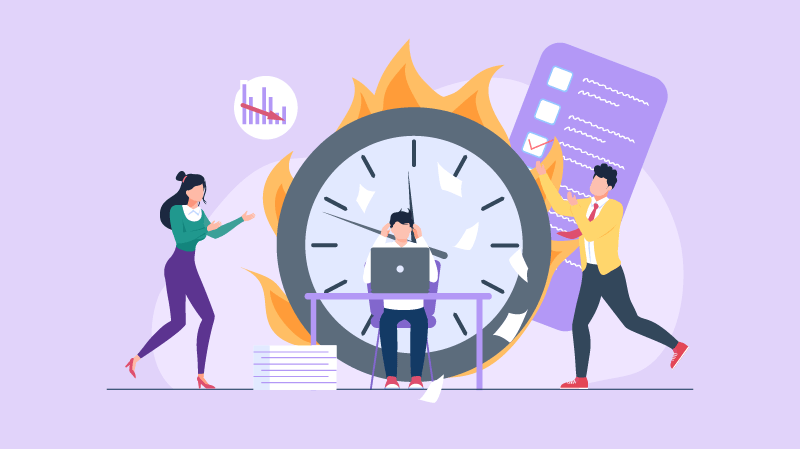
Employees who manage their time effectively are 2.4x more likely to report high engagement levels at work (Gallup, 2024). Yet 82% of professionals lack a formal time management system, relying instead on ad-hoc habits that lead to missed deadlines, chronic stress, and quiet disengagement.
For HR leaders, this is not a personal productivity problem. Poor time management across teams directly erodes employee engagement, increases burnout rates, and drains organizational output. The connection is clear: when employees feel overwhelmed and out of control, they disengage.
This article covers 9 research-backed time management techniques that HR teams can implement to reduce time-related stress and measurably improve engagement scores.
Why Time Management Directly Impacts Employee Engagement
Employees who consistently miss deadlines or feel overwhelmed report 41% lower engagement than peers who feel in control of their workday (Harvard Business Review, 2023). Time management is not about squeezing more tasks into fewer hours. It is about giving employees the structure to focus on meaningful work — the primary driver of engagement.
Three factors connect time management to engagement:
- Autonomy and control — Employees who manage their time feel ownership over their work. Gallup identifies autonomy as 1 of 12 core engagement drivers.
- Reduced cognitive overload — When employees follow a time management system, they make 37% fewer context switches per day (University of California, Irvine), reducing mental fatigue.
- Visible progress — Structured time blocks create a sense of daily accomplishment. The Progress Principle (Amabile & Kramer, Harvard) shows that small, daily wins are the single strongest motivator at work.
HR Insight: Time management is not a training topic — it is an engagement lever. Organizations that embed time management into onboarding and manager coaching see 23% higher 90-day engagement scores in new hires (Brandon Hall Group, 2024).
9 Time Management Techniques That Boost Employee Engagement
Click each technique to expand the full breakdown.
Delegation reduces individual workload by 25-30% when implemented systematically (McKinsey, 2023). Employees who delegate non-essential tasks report lower burnout rates and higher job satisfaction because they spend more time on work that matches their skills.
A practical framework for HR teams:
- Audit task lists weekly — Identify tasks that do not require the employee's core expertise
- Match tasks to skill development goals — Delegate tasks that align with a team member's growth plan, turning routine redistribution into a learning opportunity
- Set clear ownership — Define the outcome, deadline, and decision authority for each delegated task
Delegation signals trust. Employees who receive delegated responsibilities score 18% higher on engagement surveys in the "manager relationship" category (Gallup Q12).
Employees spend an average of 41% of their workday on low-priority tasks that contribute minimally to their goals (Asana Anatomy of Work Index, 2024). The Eisenhower Matrix categorizes tasks into 4 quadrants:
| Urgent | Not Urgent | |
|---|---|---|
| Important | Do First — Crisis response, hard deadlines | Schedule — Strategic projects, skill development |
| Not Important | Delegate — Routine requests, most emails | Eliminate — Time-wasters, unnecessary meetings |
HR leaders can embed this framework into weekly team check-ins. When managers ask "What quadrant are your top 3 tasks in this week?", it shifts focus from activity to impact.
Employees who focus on high-impact work (Quadrant 2) report 33% higher purpose and meaning scores — a top-3 engagement predictor (Gallup).
It takes an average of 23 minutes and 15 seconds to refocus after an interruption (University of California, Irvine). Time blocking assigns specific calendar slots to specific tasks, creating protected periods for deep, focused work.
- Establish "Focus Fridays" or daily deep-work hours — Company-wide blocks where meetings are not scheduled
- Coach managers to protect blocks — A blocked calendar is only effective if managers respect it
- Track block adherence — Teams that maintain 60%+ of their blocked time see a 28% increase in task completion rates
Flow states — which require 90+ minutes of uninterrupted focus — correlate with higher intrinsic motivation and job satisfaction (Csikszentmihalyi, 1990). Time blocking creates the conditions for flow.
79% of employees say flexible work schedules are a top-3 factor in engagement (SHRM, 2024). Workplace autonomy over scheduling shifts the dynamic from time-based monitoring to outcome-based accountability.
- Core hours model — 4 overlapping hours for collaboration (e.g., 10am-2pm), flexible outside that window
- Weekly deliverables, not daily check-ins — Define 3-5 measurable outcomes per week per employee
- Trust-first culture — Organizations using flexible scheduling with clear outcomes report 21% lower voluntary turnover (Gartner, 2024)
From the field: IBS Software saw a 7x increase in platform engagement and 198% growth in peer-to-peer recognition after shifting from delayed, manager-only recognition to real-time, employee-driven recognition.
Autonomy is the #1 driver of employee engagement strategies that work. Gallup's Q12 item "I have the freedom to decide how to do my work" is among the strongest predictors of overall engagement.
Employees who plan their day in advance are 29% more productive and report 20% lower stress levels (Dominican University of California). The 1-3-5 rule:
- 1 major task — The single most important outcome for the day
- 3 medium tasks — Supporting tasks that move projects forward
- 5 small tasks — Quick administrative items (emails, approvals, scheduling)
This framework works because it sets realistic expectations. Employees stop overcommitting and start completing, which builds daily momentum and confidence.
The Progress Principle (Harvard Business School) demonstrates that making visible progress on meaningful work is the #1 daily motivator. The 1-3-5 rule makes progress visible every day.
The average employee checks email 74 times per day and spends 28% of their workweek managing their inbox (McKinsey Global Institute). Each check breaks concentration and resets the 23-minute refocus timer.
- 3 fixed email windows — Morning (9am), midday (12:30pm), and afternoon (4pm), 20 minutes each
- Disable push notifications — Replace real-time alerts with batch summaries
- Create response SLAs — Internal: 24-hour. Urgent channel: 1-hour. This removes the anxiety of "missing something"
Constant notifications create continuous partial attention that directly reduces engagement. Batching restores cognitive control, a key factor in job satisfaction.
Employees attend an average of 25.6 meetings per week, and 67% say excessive meetings prevent them from doing their best work (Microsoft Work Trend Index, 2024).
- Audit all recurring meetings — Ask: "What decision does this meeting produce?" If unclear, cancel it
- Enforce the 2-pizza rule — No meeting should have more attendees than 2 pizzas can feed (6-8 people)
- Implement "No Meeting Wednesdays" — Employees report 35% more deep work output on meeting-free days
- Default to 25/50 minutes — Replace 30- and 60-minute defaults with shorter slots
Research: Organizations that reduced meetings by 40% saw a 71% increase in employee satisfaction and a 52% decrease in micromanagement perception (MIT Sloan, 2022).
Every unnecessary meeting is 30-60 minutes an employee cannot spend on work that drives meaning and progress — the two strongest engagement predictors.
Multitasking reduces cognitive performance by up to 40% and increases error rates by 50% (American Psychological Association). The human brain does not multitask — it rapidly switches between tasks, paying a cognitive toll each time.
- Reframe productivity culture — Reward completion over activity
- Pomodoro Technique for teams — 25 minutes focused work, 5-minute break, repeat 4 times. Tools like Toggl Track (5M+ users) and Forest make this easy to adopt
- Align with recognition programs — Recognize focused deep work outputs, not hours logged
Single-tasking enables the flow state. Flow correlates with 500% higher productivity (McKinsey) and is one of the strongest predictors of workplace engagement.
Organizations using integrated time management tools see a 27% increase in team productivity within 90 days of adoption (Forrester, 2024).
| Category | Tools | Best For |
|---|---|---|
| Time Tracking | Toggl Track, Clockify, RescueTime | Visibility into time spent per task |
| Task Planning | Todoist, TickTick, Microsoft To Do | Daily 1-3-5 planning and goal setting |
| Focus | Forest, Freedom, Serene | Blocking distractions and deep work |
| Calendar Mgmt | Reclaim.ai, Clockwise, SavvyCal | AI-powered focus block scheduling |
| Engagement | Vantage Circle, Culture Amp, Lattice | Connecting time management to recognition |
Scale: Vantage Circle powers recognition and engagement for 3.2 million+ users across 700+ organizations in 100+ countries — including Wipro, DHL, Bosch, BMW, and Infosys.
The goal is not to monitor employees — it is to give them visibility into their own patterns. Self-awareness about time use increases self-management capability, which directly correlates with higher engagement.
Technique Comparison: Best Fit by Team Type
| Technique | Best For | Engagement Impact | Effort |
|---|---|---|---|
| Strategic Delegation | Overloaded managers, growing teams | High | Medium |
| Eisenhower Matrix | All teams, especially cross-functional | High | Low |
| Time Blocking | Knowledge workers, engineers, writers | High | Low |
| Flexible Scheduling | Hybrid/remote teams | High | Medium |
| 1-3-5 Daily Planning | All employees, especially new hires | Medium | Low |
| Email Batching | Email-heavy roles (HR, Sales, Support) | Medium | Low |
| Meeting Audit | Meeting-heavy orgs (50+ meetings/week) | High | Medium |
| Single-Tasking | Creative and analytical roles | High | Low |
| Time Management Tools | Tech-forward teams, remote orgs | Medium | Medium |
How to Measure Time Management's Impact on Engagement
Implementing time management techniques without measuring engagement impact is guesswork. Track these 4 metrics quarterly:
- Engagement pulse scores — Run a 5-question monthly pulse (Gallup Q12 subset) before and 90 days after implementing time management programs
- Deep work hours — Track via calendar analytics (Clockwise, Reclaim.ai). Target: 60%+ in uninterrupted blocks
- Meeting reduction rate — Measure total meeting hours per employee per week. Target: 30% reduction within one quarter
- Task completion vs. overcommitment ratio — Compare planned tasks to completed tasks weekly. Below 70% signals overcommitment
3 Common Pitfalls HR Teams Should Avoid
Time management programs fail when they become another top-down mandate. Avoid these 3 critical mistakes:
1. Surveillance disguised as time tracking. Monitoring keystrokes or screen time destroys trust. Time management tools should give employees insights into their own patterns, not give managers a surveillance feed. 72% of employees say monitoring tools decrease their engagement (Gartner, 2024).
2. One-size-fits-all mandates. A developer's ideal system looks nothing like a recruiter's. Offer 3-4 technique options and let teams choose what fits. Autonomy in choosing the technique is as important as autonomy in work itself.
3. Ignoring manager enablement. Managers control 70% of variance in team engagement (Gallup). If managers do not model and support time management practices, employees will not adopt them. Train managers first, then roll out to teams.
Beyond Time Management: Building an Engagement-First Culture
Time management is one lever in a broader engagement strategy. The most effective organizations combine structured time practices with recognition, wellness, and purpose-driven work design.
When employees manage their time effectively and feel recognized for their contributions, engagement compounds. Rewards and recognition programs close the loop: employees do focused, meaningful work — and the organization acknowledges it. High-recognition cultures outperform on motivation (+18 pts), intent to stay (+21 pts), and pride (+16 pts) according to Vantage Circle's study with Great Place to Work.
If your team is struggling with time management, examine whether the root cause is workload management, work-life balance, or a lack of employee wellness programs. These issues are interconnected — fixing one without addressing the others produces limited results.
Related Reading
Frequently Asked Questions
Build an Engagement Culture That Lasts
See how Vantage Circle's recognition and engagement platform helps 3.2M+ employees across 700+ organizations connect time management, recognition, and wellness.
Schedule a Free Demo
This article is written by Mrinmoy Rabha. He has worked in the human resources environment and has elevated recognition and rewards through his insightful and detailed writing. He aims to enhance the practice of Recognition in the workplace with new ideas and innovation that will help shape the work culture. For any related queries, contact editor@vantagecircle.com