Employee engagement is alarmingly low around the world. According to Gallup's State of the Global Workplace: 2025 Report, only 21% of employees globally are engaged at work. The majority remain disconnected or indifferent.
This low engagement has measurable consequences for productivity and retention.
In the United States, the numbers are equally concerning. Gallup data shows that just 31% of U.S. employees were engaged at work in 2024. That is the lowest level in more than a decade.
Employee rewards and recognition play a direct role in shaping these numbers. They influence how employees perceive their work, their leaders, and the company's culture.
Employee rewards are structured incentives, financial or non-financial, that organizations use to recognize contribution, reinforce behavior, and motivate performance.
Enterprise data from large-scale programs reveals a consistent finding: the mix of reward types matters more than the budget behind any single type. Programs achieving 93% participation rates do not rely on one reward channel. They layer six distinct types, each serving a different behavioral purpose.
This guide analyzes those six types and shows which ones drive the highest participation growth in enterprise programs. For a detailed look at the advantages and disadvantages of each approach, see our reward systems analysis.
The 6 Types of Employee Rewards
Enterprise recognition programs use six distinct reward types. Each serves a different behavioral purpose and addresses a different dimension of the employee experience.
Before diving into each type, here is a quick-reference overview.
| Reward Type | What It Is | Who Delivers It | Budget Required | Best For |
|---|---|---|---|---|
| Intrinsic | Values-aligned recognition that reinforces purpose and belonging | Peers, managers, leaders | None | Culture alignment, daily motivation |
| Monetary | Points-based awards, SPOT Awards, named award programs | Managers, HR, leadership | Yes | High-impact contributions, milestone achievements |
| Non-Monetary | Digital badges, eCards, social appreciation posts | Anyone in the organization | None | High-frequency recognition, visibility |
| Peer-to-Peer | Recognition from colleagues without manager approval | Peers | None or low | Daily appreciation, cross-team collaboration |
| Service Milestone | Automated tenure-based awards at career anniversaries | System-triggered, HR-managed | Yes | Retention, loyalty celebration |
| Experiential / Choice-Based | Gift cards, curated experiences, marketplace redemption | HR-funded, employee-chosen | Yes | Personalization, global equity |
The sections below unpack each type with enterprise data.
1. Intrinsic Rewards: Recognition Culture and Values Alignment
Intrinsic rewards come from within the employee. They are psychological, emotional, and deeply personal. They shape how employees feel about their work, their growth, and their purpose.
Organizations cannot hand out intrinsic rewards to employees. What they can do is create the conditions for their emergence. Three conditions sit at the core of intrinsic motivation.

The first is purpose. Employees feel rewarded when their work creates a visible impact. When people understand how their role contributes to customers, teams, or society, motivation becomes internal.
The second is autonomy. Freedom to plan work, make decisions, and manage schedules signals confidence in the employee. This sense of ownership increases accountability and engagement.
The third is timely appreciation. Specific, timely praise from managers or peers validates effort and builds trust. Recognition works best when it highlights behaviors, not just results.
These drivers have measurable outcomes. According to the AIRe Report, recognition-driven cultures show 92% retention compared to 76% in low-recognition cultures. With 79% of Gen Z employees seeking frequent recognition, intrinsic rewards are increasingly critical for younger workforce segments. Gallup's longitudinal research confirms this: employees who receive high-quality recognition are 45% less likely to leave their organization within two years.
Creating them requires intentional program design. Values-aligned recognition, public appreciation tied to company principles, and manager behaviors that consistently reinforce purpose are what make intrinsic motivation possible at scale.
To build a deeper understanding of how intrinsic motivation works in practice, see our guide on intrinsic rewards.
2. Monetary Rewards: Points, Awards, and Tangible Incentives
Monetary rewards are the most familiar type in enterprise programs. But in high-performing organizations, they go well beyond one-time bonuses. And yet, the gap persists. Harvard Business School research found that more than 80% of American employees do not feel recognized or rewarded, despite companies spending over a fifth of their budgets on wages. What employees value beyond cash is feeling appreciated.
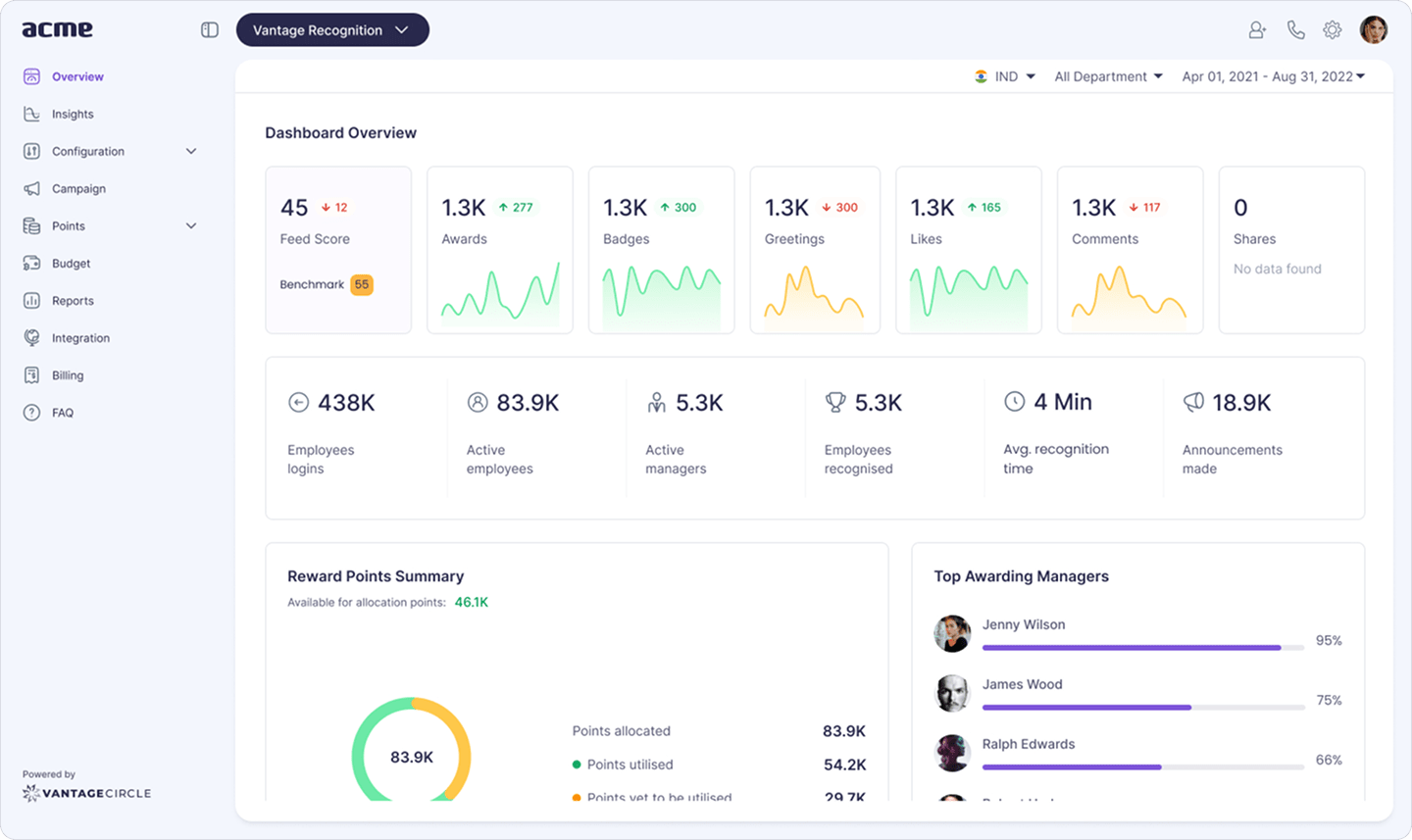
In practice, monetary rewards include points-based awards, SPOT Awards, and named award programs with budget governance structures. Points systems offer real choice. Employees select rewards that matter to them, which increases perceived value and satisfaction.
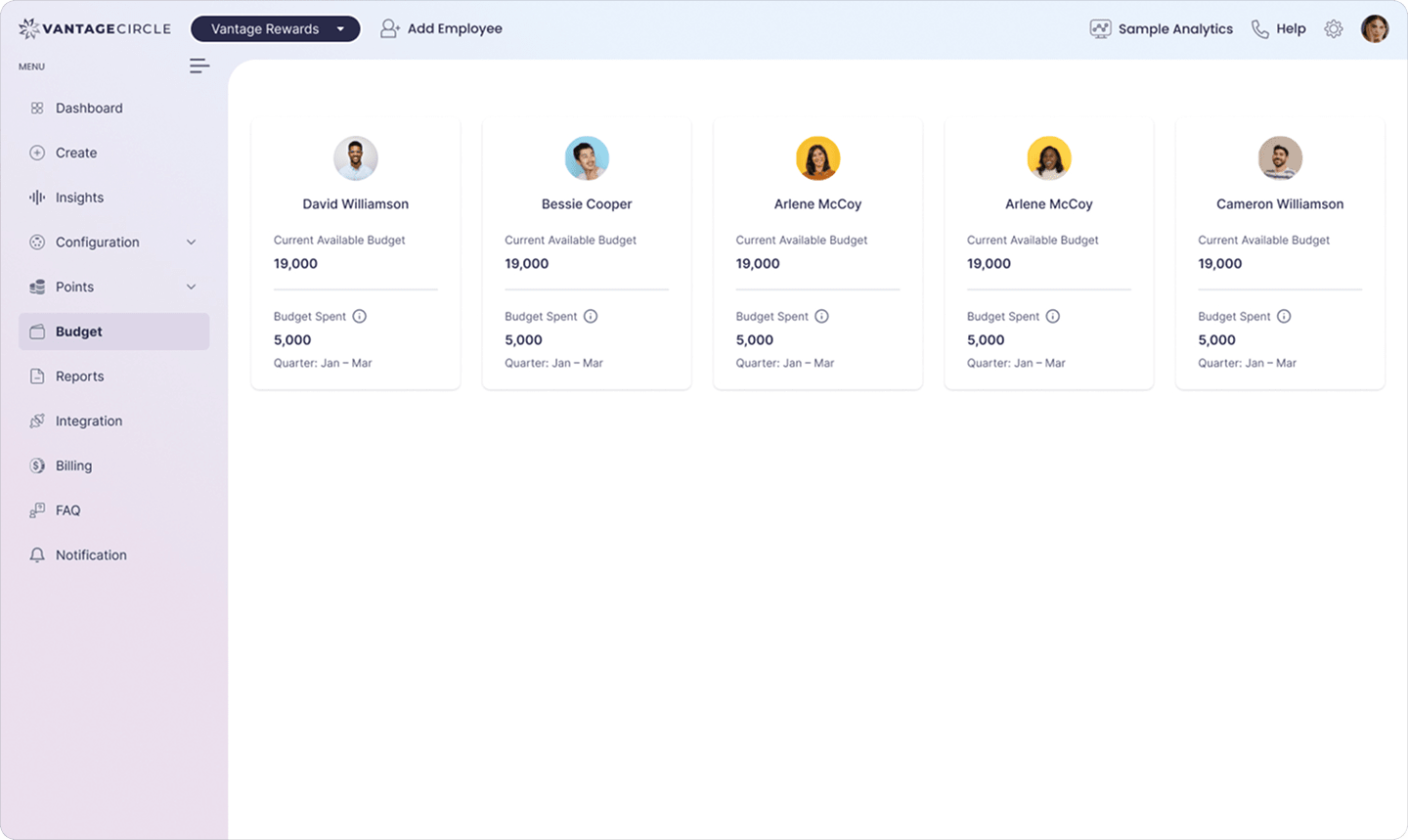
The data supports this. At IBS Software, overall monetary recognition rose 77% in two years following the implementation of a structured points-based program.
One important design consideration for global organizations is purchasing power equity. SOLI adjustment, which stands for Standard of Living Index, ensures that point values carry equivalent purchasing power across different geographies. Without it, the same monetary reward can feel meaningfully different to employees in different countries.
The broader pattern the data reveals is this: monetary rewards drive impact at key moments. But they work best when layered with high-frequency non-monetary recognition, rather than used as the sole reward channel.
For a deeper look at how monetary and non-monetary approaches compare, see our analysis of cash vs non-cash incentives.
3. Non-Monetary Rewards: Badges, Social Recognition, and Appreciation
Non-monetary rewards do not involve money. Yet their impact on participation and culture is significant.
This category includes digital badges, eCards, social appreciation posts, and physical recognition cards. These rewards are social and public. Badges and tokens reinforce behaviors, encourage peer recognition, and build culture through visibility.

Recognition in meetings, newsletters, internal platforms, or digital walls builds reputation and pride. Public appreciation often carries more emotional weight than monetary value.
The enterprise data on non-monetary rewards is hard to ignore. Wipro saw a 97.5% increase in non-monetary awards over two years. LTTS recorded 68% growth in non-monetary recognition over the same period.
The reason non-monetary recognition scales so effectively comes down to one factor: zero budget requirement. Every employee can participate. This drives recognition coverage rates that monetary-only programs simply cannot match.
There is also a frequency advantage. Monetary rewards are tied to budgets and approval processes, which limit how often they can be given. Non-monetary recognition has no such constraint. It can happen daily, across teams, at every level of the organization.
For implementation guidance, see our resource on non-monetary incentives and symbolic recognition.
4. Peer-to-Peer vs Manager-Driven Rewards
Traditional reward programs are manager-driven. They require budget approval. A manager must initiate the process before an employee can be appreciated. That creates a bottleneck limiting frequency and participation.
Peer-to-peer recognition removes that bottleneck entirely. Any employee can appreciate a colleague without waiting for manager authorization or a budget allocation. The result is a recognition culture that operates at the speed of everyday work.

The enterprise data on this is consistent across programs.
Tata Communications saw a 185% surge in peer-to-peer non-monetary recognition between FY2020 and FY2025. IBS Software recorded a 198% increase in peer-to-peer recognition in two years. Qualitest grew peer recognition by 74% between June 2022 and 2024.
The pattern is clear. When organizations remove the approval bottleneck, peer recognition scales faster than any other reward type. And it does so without additional budget.
This does not mean manager-driven recognition loses its value. Manager recognition carries authority and weight that peer appreciation cannot fully replicate. The strongest programs use both. Peer-to-peer recognition drives daily frequency. Manager recognition reinforces high-impact moments.
To understand the business case for investing in this model, see our data on the ROI of employee recognition.
5. Service Milestone and Tenure Rewards
Tenure deserves recognition. Yet in many organizations, work anniversaries pass without acknowledgment. That is a missed retention opportunity.
Service milestone rewards are automated tenure-based awards tied to career anniversaries. They typically include anniversary points, personalized Yearbooks, and commemorative badges at one, three, five, and ten-year marks. Retirement recognition takes this further, with farewell ceremonies, memory books, and curated catalogs that honor long service in a way standard recognition cannot.

Milestones serve a different behavioral purpose than daily recognition. They create what practitioners call "stay moments." These are points in an employee's tenure where attrition risk is highest. A well-designed milestone program addresses that risk directly by making loyalty visible and valued.
The scale at which this can operate is significant. Wipro has issued over 30,000 Long Service Awards since 2021 through an automated milestone program.
Automation is what makes this possible. Manually tracking anniversaries across a large workforce is administratively unmanageable. Automated milestone programs ensure no anniversary goes unrecognized, regardless of team size or geography.
The business case is straightforward. According to SHRM, replacing an employee costs, on average, from 50% to 200% of their annual salary. Milestone recognition is a low-cost intervention that directly addresses one of the most predictable attrition triggers.
6. Experiential and Choice-Based Rewards
Not every employee wants the same thing. That is the core problem with one-size-fits-all reward programs. Experiential and choice-based rewards solve it.
This category includes curated experiences, gift cards, merchandise, and marketplace redemption where the employee selects their own reward. The behavioral principle is straightforward.When employees choose their own rewards, perceived value and satisfaction increase. Flexible options, like points or experience-based rewards, increase employee satisfaction without extra cost.

Experiences also create something that objects cannot. Trips, curated events, and team outings strengthen relationships and build emotional connections. They create lasting memories that reinforce a sense of belonging and loyalty.
For global organizations, choice-based rewards introduce an additional design consideration. A reward catalog that feels generous in one country may feel underwhelming in another. SOLI-adjusted point values address this by ensuring equivalent purchasing power across geographies.
For a deeper look at this reward type, see our guide on experiential rewards for employees.
Enterprise Data: Which Reward Types Drive the Highest Participation?
Across enterprise recognition programs, one question matters most to HR leaders: which reward types actually move the needle on participation?
The data from real programs answers that question clearly.
| Reward Type | Enterprise Metric | Client | Growth Period |
|---|---|---|---|
| Non-Monetary | 97.5% increase in non-monetary awards | Wipro | 2 years |
| Non-Monetary | 68% growth in non-monetary recognition | LTTS | 2 years |
| Peer-to-Peer | 185% surge in peer-to-peer recognition | Tata Communications | FY2020-2025 |
| Peer-to-Peer | 198% increase in peer-to-peer recognition | IBS Software | 2 years |
| Peer-to-Peer | 74% growth in peer-to-peer recognition | Qualitest | June 2022-2024 |
| Monetary | 77% rise in overall monetary recognition | IBS Software | 2 years |
| Service Milestones | 30,000+ Long Service Awards issued | Wipro | Since 2021 |
| Overall Participation | 93% employee participation rate | LTTS | 2023-24 |

Two patterns emerge from this data.
The first is that non-monetary and peer-to-peer rewards consistently show the highest growth rates. The reason is structural. Both carry zero budget barriers and zero approval bottlenecks. Any employee can participate at any time. That structural openness drives exponential participation growth.
The second pattern is that monetary and milestone rewards show strong but structurally slower growth. They require budgets, triggers, and approval processes. That does not make them less valuable. It makes them different. They drive impact at specific, high-stakes moments rather than at daily frequency.
The most important finding is what happens when organizations combine all six types. LTTS achieved 93% employee participation. Wipro reached 57% recognition coverage across its workforce. Neither result came from a single reward channel. Both came from layering reward types so that every employee, regardless of role, level, or geography, had a reason to participate.
The conclusion for HR leaders is this. No single reward type is sufficient on its own. The organizations seeing the strongest participation results are the ones treating reward design as a portfolio decision, not a single investment.
How to Design a Multi-Type Reward Program
Recognition is a short-term need that has to be satisfied on an ongoing basis, weekly, maybe daily.
– Jim Harter, Chief Scientist, Gallup
The data from the previous section points to one clear conclusion. The highest-participation programs layer all six reward types. They do not default to monetary rewards alone, and they do not treat recognition as a single initiative.
Building that kind of program requires a structured approach. Here is a five-step framework based on what high-participation enterprise programs have in common.
| Step | Action | Key Question |
|---|---|---|
| 1. Define the target behavior | Clarify what outcome matters most: retention, collaboration, safety, or innovation | What behavior do we want more of? |
| 2. Know what employees value | Segment by role, generation, and work mode: desk, frontline, or remote | What reward types resonate with each group? |
| 3. Align with business goals | Match reward types to strategic priorities. Sales teams need performance incentives. Innovation teams thrive on recognition and autonomy | Which reward types serve our biggest priorities? |
| 4. Balance impact with budget | Non-monetary and peer rewards deliver high frequency at low cost. Monetary rewards deliver high impact at key moments | Where does each dollar, or zero dollars, create the most participation? |
| 5. Combine all six types | Layer foundation rewards (non-monetary and peer), impact rewards (monetary), and lifecycle rewards (milestones and experiential) | Does our program cover all six types? |
A framework alone, however, is not enough. Execution discipline is what separates high-participation programs from average ones. Three principles matter most.
Recognize close to the behavior. Timing matters more than size. Recognition delivered immediately after the behavior reinforces learning and motivation. Delayed recognition loses both relevance and emotional power.
Be specific about what you are recognizing. Generic praise barely registers. Recognition is most effective when it highlights a concrete behavior, decision, or outcome. Specificity builds trust and encourages the right behaviors to repeat.
Make recognition visible. The more employees see recognition happening around them, the greater its impact. Visibility reinforces what the organization values. It also strengthens peer learning and cultural alignment across teams.
These principles align with the AIRe Framework, which stands for Appreciation, Incentivization, Reinforcement, and eMotional Connect. It is the behavioral science methodology that underpins enterprise recognition program design. Each of the six reward types maps directly to one of these four pillars, ensuring that a multi-type program is not just operationally balanced but behaviorally grounded.
Platforms that combine monetary, non-monetary, peer, and milestone rewards in one system make this kind of program possible without managing multiple tools.
Recommended Reading: See our guides on building an employee reward program & measuring the ROI of employee recognition
Final Thoughts
Reward systems shape behavior more than policies do. They influence how employees show up, how leaders lead, and how culture evolves over time. The most effective organizations do not rely on a single incentive or annual bonus cycle. They design a balanced reward portfolio that reflects business priorities and employee expectations.
In 2026, the question is no longer whether to invest in rewards. It is how intentionally you design them.
What combination of reward types best fits your culture?
Frequently Asked Questions
Q. What are the main types of rewards for employees?
The six main types of employee rewards are intrinsic, monetary, non-monetary, peer-to-peer, service milestone, and experiential or choice-based rewards. Each serves a different behavioral purpose. The most effective programs combine multiple types based on role, workforce demographics, and business goals.
Q. What is the difference between intrinsic and extrinsic rewards?
Intrinsic rewards come from within the employee: purpose, autonomy, and meaningful recognition. Extrinsic rewards come from the organization: points, gift cards, monetary awards, and experiences. Intrinsic rewards sustain long-term engagement. Extrinsic rewards reinforce effort and outcomes in the short term. Enterprise programs need both.
Q. Which type of reward is most effective for employees?
There is no single best reward type. Enterprise data shows that programs combining all six types consistently outperform single-type programs. LTTS achieved 93% participation by layering monetary, non-monetary, peer, and milestone rewards together.

This article is written by Nilotpal M Saharia. Nilotpal M Saharia is a Senior Content Marketing Specialist & R&R Strategist at Vantage Circle, with 7 years of expertise in marketing, HR, and content strategy.
Connect with Nilotpal on LinkedIn.